document authentication Germanydental document translation Germanyapostille Iran Germany

Authenticating Dental Documents for Germany: The Full Chain from University to Embassy (2026)

Iran is not a Hague Apostille member; your documents travel through the Health Ministry, Justice Ministry, and Foreign Ministry. The court-sworn translator requirement, the 'als Zahnarzt' wording trap, the 13-item Approbation file, and the Tehran-to-Yerevan visa reality.

Authenticating Dental Documents for Germany: The Full Chain from University to Embassy (2026)

In German files, most rejections and re-dos trace back neither to the exam nor to the language — but to documents. The reason is structural: Iran is not a member of the Hague Apostille Convention, so there is no "one stamp and done" shortcut for Iranian documents; every record must travel the full authentication chain. This article walks that chain step by step, with the two classic traps, the complete file list, and the special realities of 2026.

The academic chain: five stations

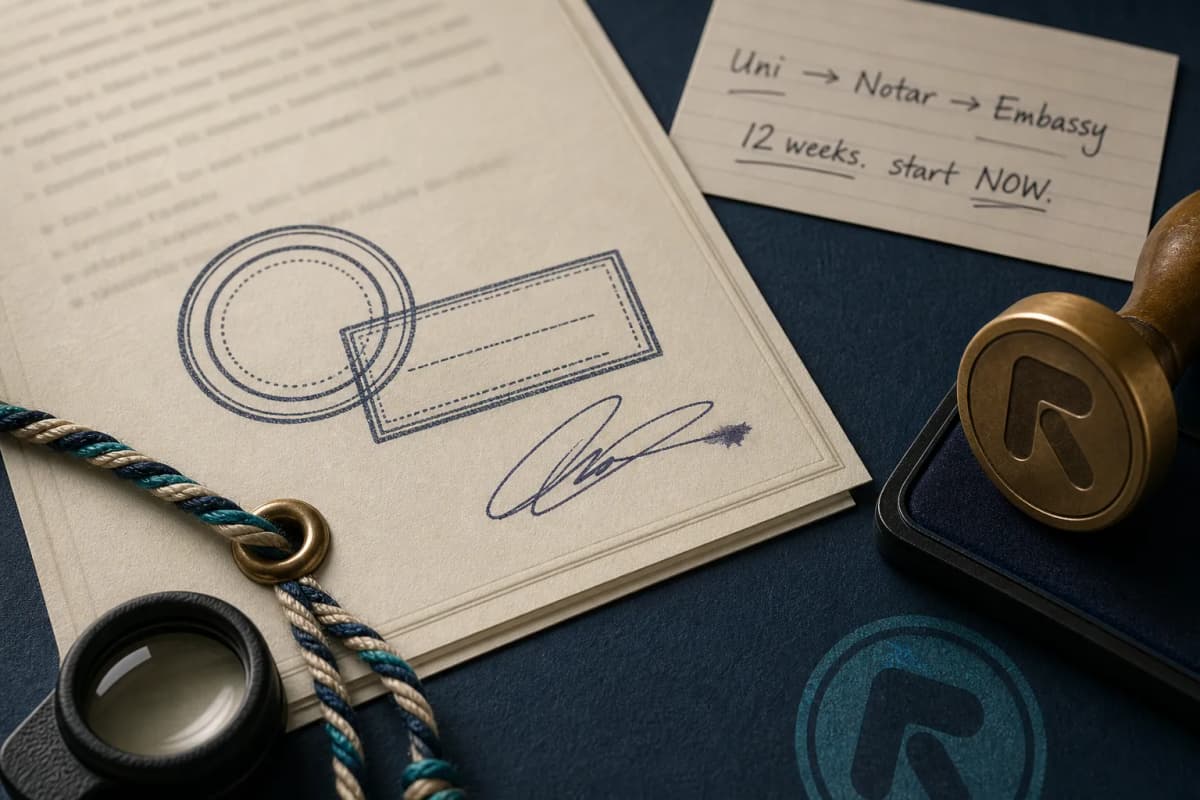
For the dental degree, transcripts, and university certificates, the order of stations is fixed — and shuffling it is the single most common cause of re-work:

  1. The university graduates' office — issuing/validating the original
  2. The Health Ministry's education services centre — the "translatable" stamp (the prerequisite for every later step; without it, no translation office should translate)
  3. A certified translation office — the official translation
  4. The Ministry of Justice — validating the translator's seal
  5. The Ministry of Foreign Affairs, then the German embassy/consulate — final legalisation

Graduates of Azad University have one extra station: the central organisation's validation before the Health Ministry — because dentistry is regulated by the Health Ministry regardless of the university's type.

Personal documents (civil records, marriage, police clearance) run a parallel track: notary public → Justice Ministry → Foreign Ministry → embassy. Inside Iran, done without errors, the whole process typically takes three to six weeks and costs roughly 3–6 million tomans (May 2026 rates). If you are already abroad, the Mikhak consular portal lets you grant power of attorney to family for exactly this chain — the standard fix for the forgotten document, at the price of weeks per round.

Trap one: Iranian certified translations are not enough for Germany

Unlike Australia, which accepts Iranian certified translations, German authorities do not recognise translations from Iranian translation offices. The German text must be produced or certified by an "öffentlich bestellt" translator — sworn and court-authorised in Germany. The standard pattern: authenticate the originals in Iran, then commission the German translations from a sworn translator (in Germany or remotely). Budget separately for this — pricing is per page/line, and a complete dental file runs to several hundred euros — and archive clean digital scans of everything from day one; sworn translators usually start from scans.

Trap two: a service certificate without the right wording is dead weight

Your post-graduation service period is a genuine asset in a German file — on one condition of wording. The certificate must state explicitly that you worked "als Zahnarzt" — in the capacity of a dentist — with start and end dates and clinical duties. A vague letter confirming "collaboration at a health centre" carries almost no weight in the assessment of your clinical history. Re-read the original text through that lens before translating; fixing the wording at home is easy, fixing it mid-process in Germany is not. (How service experience counts in the other four destinations: this article.)
Authenticating Dental Documents for Germany: The Full Chain from University to Embassy (2026)

The German file: thirteen core items

A complete Approbation/Kenntnisprüfung file typically wants these — all with the authentication chain and sworn German translations:

The dental degree; full transcripts; course/hour breakdowns (some states, for equivalence files); the service certificate with "als Zahnarzt"; the medical council card and registration certificate; a Good Standing certificate (limited validity — time it to your submission); police clearance from Iran (and later a German Führungszeugnis); birth/passport documents (and marriage certificate if applicable); a health certificate from a German-licensed physician (at the Approbation stage — it cannot be obtained in Iran; build it into a trip); a CV in tabular Lebenslauf style; language certificates (B2 and FSP/telc); the radiation-protection course certificate (required from May 2026); and standard photographs. Each state's exact list differs slightly — take the official checklist of your Approbationsbehörde as the master, and our general checklist for the Iran phase.

The 2026 situation: Tehran closed, Yerevan open

The German embassy in Tehran closed its visa section on 14 February 2026, and since May 2026 Iranian visa applications are formally handled by the German embassy in Yerevan. For planning purposes: appointments and interviews for national visas (including §16d and the Chancenkarte) now involve a trip to Armenia, and processing of Iranian files is reported slower than baseline (8–12 weeks for a Chancenkarte against the usual 4–6). That doubles the value of a complete file at the first appointment — every missing document is another trip.

Plan the final legalisation station with the same reality: before fixing a Yerevan appointment, write to the consulate about the current procedure for legalising Iranian documents, so nothing is left without its final stamp.

Frequently asked questions

How do I find a sworn translator, and what does it cost? Germany's official court-translator database (searchable online, Persian included) is the authoritative list; many Persian-speaking sworn translators take remote commissions. Pricing is per line/page; a full dental file usually runs to several hundred euros — quotes from two or three translators differ meaningfully.

Are Iranian Persian-to-German translations truly accepted nowhere? For the Approbation file and recognition authorities, the standard is the German-authorised translator's seal; the safe route is authentication in Iran, translation within the German system. Building a file on exceptions risks complete re-work.

Must I send originals? The working rule: certified copies (beglaubigte Kopie) suffice, originals only for inspection. Never post a sole original — German certified copies are made locally (Bürgeramt/notary).

Must the whole chain be finished before language and visa? No — language starts today; the §16d/Chancenkarte application works with the core documents. What demands one-hundred-percent completeness is the Approbation/exam file; that difference is precisely why the chain should run in parallel with your language study.

Can I file in several states? Formally your recognition file proceeds in one state; choose it on exam queue and cost plus supervised-work prospects, then build the document chain for that state.

Each section in one line

Walk the five stations in order (the "translatable" stamp before any translation); German translations only from a sworn translator; the service certificate only with "als Zahnarzt"; match the thirteen items against your state's checklist; time the dated certificates to your submission calendar; and take Yerevan with a flawless file. Done right, documents are the hidden half of success on the German route — the half that, unlike the exam, is one hundred percent within your control.


Where documents sit in the full German route — language, visa, and the Kenntnisprüfung — in our Germany guide.

RxApply

RxApply

Authenticating Dental Documents for Germany: The Full Chain from University to Embassy (2026)

Iran is not a Hague Apostille member; your documents travel through the Health Ministry, Justice Ministry, and Foreign Ministry. The court-sworn translator requirement, the 'als Zahnarzt' wording trap, the 13-item Approbation file, and the Tehran-to-Yerevan visa reality.

Authenticating Dental Documents for Germany: The Full Chain from University to Embassy (2026)

In German files, most rejections and re-dos trace back neither to the exam nor to the language — but to documents. The reason is structural: Iran is not a member of the Hague Apostille Convention, so there is no "one stamp and done" shortcut for Iranian documents; every record must travel the full authentication chain. This article walks that chain step by step, with the two classic traps, the complete file list, and the special realities of 2026.

The academic chain: five stations

For the dental degree, transcripts, and university certificates, the order of stations is fixed — and shuffling it is the single most common cause of re-work:

  1. The university graduates' office — issuing/validating the original
  2. The Health Ministry's education services centre — the "translatable" stamp (the prerequisite for every later step; without it, no translation office should translate)
  3. A certified translation office — the official translation
  4. The Ministry of Justice — validating the translator's seal
  5. The Ministry of Foreign Affairs, then the German embassy/consulate — final legalisation

Graduates of Azad University have one extra station: the central organisation's validation before the Health Ministry — because dentistry is regulated by the Health Ministry regardless of the university's type.

Personal documents (civil records, marriage, police clearance) run a parallel track: notary public → Justice Ministry → Foreign Ministry → embassy. Inside Iran, done without errors, the whole process typically takes three to six weeks and costs roughly 3–6 million tomans (May 2026 rates). If you are already abroad, the Mikhak consular portal lets you grant power of attorney to family for exactly this chain — the standard fix for the forgotten document, at the price of weeks per round.

Trap one: Iranian certified translations are not enough for Germany

Unlike Australia, which accepts Iranian certified translations, German authorities do not recognise translations from Iranian translation offices. The German text must be produced or certified by an "öffentlich bestellt" translator — sworn and court-authorised in Germany. The standard pattern: authenticate the originals in Iran, then commission the German translations from a sworn translator (in Germany or remotely). Budget separately for this — pricing is per page/line, and a complete dental file runs to several hundred euros — and archive clean digital scans of everything from day one; sworn translators usually start from scans.

Trap two: a service certificate without the right wording is dead weight

Your post-graduation service period is a genuine asset in a German file — on one condition of wording. The certificate must state explicitly that you worked "als Zahnarzt" — in the capacity of a dentist — with start and end dates and clinical duties. A vague letter confirming "collaboration at a health centre" carries almost no weight in the assessment of your clinical history. Re-read the original text through that lens before translating; fixing the wording at home is easy, fixing it mid-process in Germany is not. (How service experience counts in the other four destinations: this article.)

Authenticating Dental Documents for Germany: The Full Chain from University to Embassy (2026)

The German file: thirteen core items

A complete Approbation/Kenntnisprüfung file typically wants these — all with the authentication chain and sworn German translations:

The dental degree; full transcripts; course/hour breakdowns (some states, for equivalence files); the service certificate with "als Zahnarzt"; the medical council card and registration certificate; a Good Standing certificate (limited validity — time it to your submission); police clearance from Iran (and later a German Führungszeugnis); birth/passport documents (and marriage certificate if applicable); a health certificate from a German-licensed physician (at the Approbation stage — it cannot be obtained in Iran; build it into a trip); a CV in tabular Lebenslauf style; language certificates (B2 and FSP/telc); the radiation-protection course certificate (required from May 2026); and standard photographs. Each state's exact list differs slightly — take the official checklist of your Approbationsbehörde as the master, and our general checklist for the Iran phase.

The 2026 situation: Tehran closed, Yerevan open

The German embassy in Tehran closed its visa section on 14 February 2026, and since May 2026 Iranian visa applications are formally handled by the German embassy in Yerevan. For planning purposes: appointments and interviews for national visas (including §16d and the Chancenkarte) now involve a trip to Armenia, and processing of Iranian files is reported slower than baseline (8–12 weeks for a Chancenkarte against the usual 4–6). That doubles the value of a complete file at the first appointment — every missing document is another trip.

Plan the final legalisation station with the same reality: before fixing a Yerevan appointment, write to the consulate about the current procedure for legalising Iranian documents, so nothing is left without its final stamp.

Frequently asked questions

How do I find a sworn translator, and what does it cost? Germany's official court-translator database (searchable online, Persian included) is the authoritative list; many Persian-speaking sworn translators take remote commissions. Pricing is per line/page; a full dental file usually runs to several hundred euros — quotes from two or three translators differ meaningfully.

Are Iranian Persian-to-German translations truly accepted nowhere? For the Approbation file and recognition authorities, the standard is the German-authorised translator's seal; the safe route is authentication in Iran, translation within the German system. Building a file on exceptions risks complete re-work.

Must I send originals? The working rule: certified copies (beglaubigte Kopie) suffice, originals only for inspection. Never post a sole original — German certified copies are made locally (Bürgeramt/notary).

Must the whole chain be finished before language and visa? No — language starts today; the §16d/Chancenkarte application works with the core documents. What demands one-hundred-percent completeness is the Approbation/exam file; that difference is precisely why the chain should run in parallel with your language study.

Can I file in several states? Formally your recognition file proceeds in one state; choose it on exam queue and cost plus supervised-work prospects, then build the document chain for that state.

Each section in one line

Walk the five stations in order (the "translatable" stamp before any translation); German translations only from a sworn translator; the service certificate only with "als Zahnarzt"; match the thirteen items against your state's checklist; time the dated certificates to your submission calendar; and take Yerevan with a flawless file. Done right, documents are the hidden half of success on the German route — the half that, unlike the exam, is one hundred percent within your control.


Where documents sit in the full German route — language, visa, and the Kenntnisprüfung — in our Germany guide.

RxApply

About the author

RxApply

The RxApply editorial team — coaches, alumni, and operations — writes field notes from the cohort. Each article lists the coach who lived the path it describes.

Related field notes

More from the blog.

Curated by coaches. Read in order if you’re starting from zero.

All field notes
RxApply