INBDE examwhat is the INBDEINBDE for international dentists

What Is the INBDE? A 2026 Guide for Internationally Trained Dentists

Structure, fees, pass rates, and international test centres for the INBDE — plus where the exam fits in your IDP application, the retake rules, and what changed for foreign-trained candidates in 2026.

What Is the INBDE? A 2026 Guide for Internationally Trained Dentists

Every dental licensure route in the United States — whichever state it runs through — passes one common checkpoint: the INBDE. The Integrated National Board Dental Examination replaced the old NBDE Part I and Part II in August 2020 and is now the single national knowledge exam in American dentistry. If your degree comes from outside the US and Canada, the INBDE is usually the first measurable step in your file — before IDP admission, before any visa, and before every bigger decision.

This guide draws on official JCNDE data and the documented experience of international candidates through June 2026.

The format: two days, roughly 500 questions

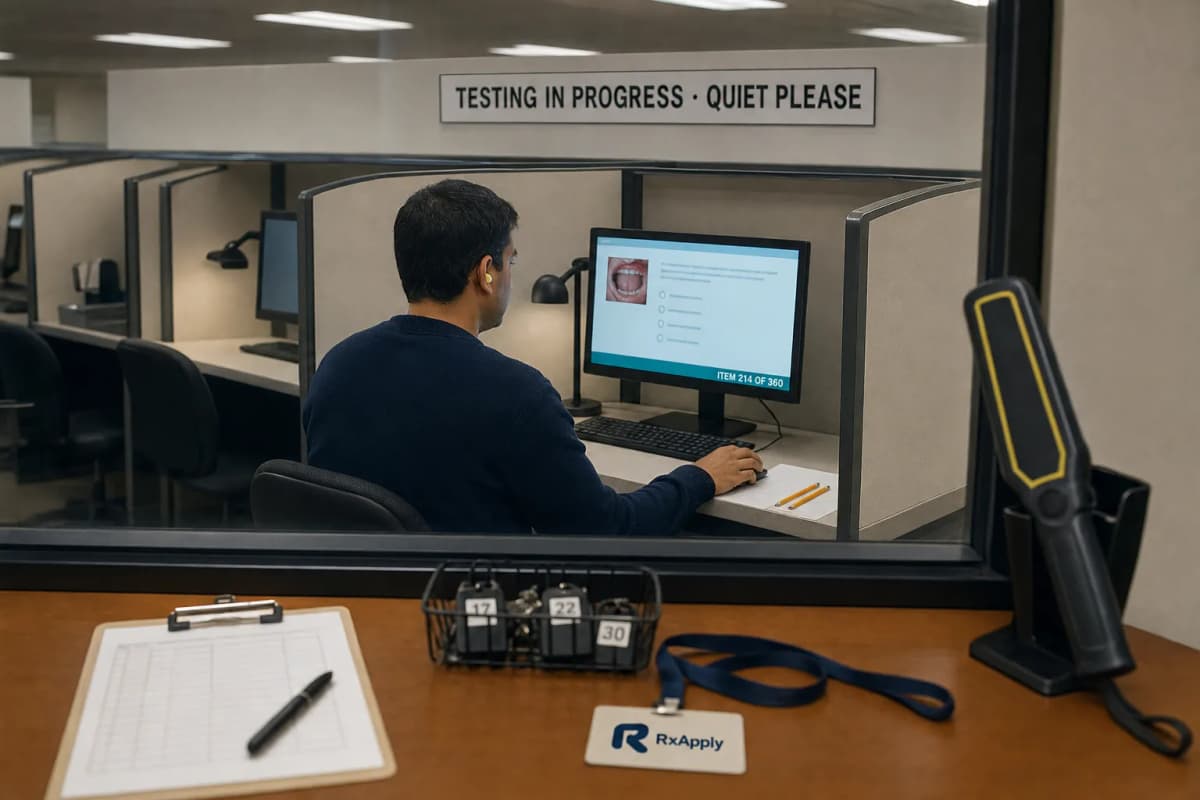
The INBDE is run by the Joint Commission on National Dental Examinations (JCNDE) under the ADA. It spans two days — 360 items on Day 1 and around 140 on Day 2, about 12.5 hours in total — and both days must be completed within a single seven-day window.

Unlike its predecessors, the INBDE weaves basic science and clinical science together. Instead of chapters of anatomy and pathology, you face patient scenarios: a history, findings, often an image or radiograph, and a question that pulls on pharmacology, pathology, and treatment considerations all at once. For a dentist who left the basic sciences behind years ago, that is both good news and a challenge: less pure memorisation, more clinical reasoning.

Results are reported as pass/fail only — there is no numerical score. That has real strategic weight for IDP applicants: programs cannot rank candidates by INBDE score, so they lean harder on GPA, bench tests, and interviews. As of May 2026, despite persistent requests from candidates, JCNDE has announced no plan to restore numerical scoring, citing reliability and validity concerns.

What it costs in 2026

The base exam fee is USD 890. Candidates from non-CODA schools — which means virtually all internationally trained applicants — also pay a USD 435 processing fee. With incidentals, a first attempt typically lands between USD 1,325 and 1,524. And because the exam is not offered in some countries of origin (including Iran), flights, entry to the host country, and at least a week's accommodation sit on top — a realistic all-in budget for one complete attempt from abroad runs to USD 2,000–3,000.

The retake rules are clear and strict: a maximum of 5 attempts or 5 years from your first attempt (whichever comes first), then one attempt per year; at least 60 days between attempts; and no more than 4 attempts in any 12 months. The practical translation: the INBDE is not an exam to "go and see what it's like." Every attempt should be a fully prepared one, because the clock starts with attempt number one.

The pass rates you should take seriously

The official 2024 data paints a clear picture: first-time candidates from US (CODA) schools passed at 95.2 percent. For graduates of non-accredited programs — the group internationally trained dentists belong to — the first-attempt rate was 74.7 percent, and for repeat takers just 47.2 percent.

One more important detail: JCNDE raised the performance standard in June 2024, and candidate reports since then put the non-accredited pass rate closer to 60–65 percent. That 47 percent repeat figure carries its own message too: retaking without changing how you study rarely changes the result.

The practical takeaway is simple: this is not an exam you clear with two months of review. Successful candidates typically report four to eight months of structured study, usually combining one comprehensive review source (Mosby or First Aid), one card-based system (Dental Decks), and a case-based question bank that mirrors the scenario style of the real exam. In the final month, the bulk of your time should go to timed practice exams, not re-reading.
What Is the INBDE? A 2026 Guide for Internationally Trained Dentists

Where you can sit the exam

The INBDE runs at Prometric centres, with no active centre in Iran. The most common choices for candidates in the region:

  • Dubai — the busiest option
  • Istanbul and Ankara — visa-free for Iranian passport holders
  • Yerevan — close and lower-cost
  • Doha, Bahrain, and Cairo — more limited capacity

Two exam days inside a seven-day window effectively means one full trip; many candidates book the two days with a rest day or two in between so Day 1 fatigue does not sink Day 2. Booking the centre and hotel early — especially for high-demand summer windows — is part of preparation, and so is solving payment in advance: registration needs an international card, which deserves planning of its own if you are paying from Iran.

Where the INBDE sits in your file

The recurring question: INBDE first, or IDP application first? The common pattern is to take the exam after IDP admission, but a sizeable group sits it during the application season so their file stands out in the crowded CAAPID race. If your GPA is average, a passed INBDE before applying is one of the few levers entirely in your own hands — alongside the bench test and recommendation letters.

And one 2026 reality that cannot be ignored: Presidential Proclamation 10998 has suspended F-1, J-1, and H-1B visa issuance for Iranian nationals since January 1, 2026. An INBDE pass keeps its validity, and green-card holders are exempt — but if you are in Iran without US status, weigh your visa pathway carefully before spending, and take the two-track strategy seriously. The full analysis is in our Proclamation 10998 article.

Frequently asked questions

How long does an INBDE pass stay valid? A pass does not expire; the five-year limit applies only to failed attempts.

Is the INBDE enough for a licence? No. It is necessary, not sufficient; depending on the state you will also need a clinical exam (such as ADEX) or an IDP/residency program.

When do results arrive? Usually within a few weeks through your account, with official reporting to programs and boards through the same channel.

Do I need the INBDE for specialty residency too? Yes — both specialty programs (via the PASS system) and the residency-based state licensure route require an INBDE pass.

Where do I start? Set up your credential evaluation (ECE) and official accounts, then book a test date that reflects four to eight months of honest preparation — not urgency.


Choose the US route with your eyes open: see the full costs, exams, and visa picture in our USA guide.

RxApply

RxApply

What Is the INBDE? A 2026 Guide for Internationally Trained Dentists

Structure, fees, pass rates, and international test centres for the INBDE — plus where the exam fits in your IDP application, the retake rules, and what changed for foreign-trained candidates in 2026.

What Is the INBDE? A 2026 Guide for Internationally Trained Dentists

Every dental licensure route in the United States — whichever state it runs through — passes one common checkpoint: the INBDE. The Integrated National Board Dental Examination replaced the old NBDE Part I and Part II in August 2020 and is now the single national knowledge exam in American dentistry. If your degree comes from outside the US and Canada, the INBDE is usually the first measurable step in your file — before IDP admission, before any visa, and before every bigger decision.

This guide draws on official JCNDE data and the documented experience of international candidates through June 2026.

The format: two days, roughly 500 questions

The INBDE is run by the Joint Commission on National Dental Examinations (JCNDE) under the ADA. It spans two days — 360 items on Day 1 and around 140 on Day 2, about 12.5 hours in total — and both days must be completed within a single seven-day window.

Unlike its predecessors, the INBDE weaves basic science and clinical science together. Instead of chapters of anatomy and pathology, you face patient scenarios: a history, findings, often an image or radiograph, and a question that pulls on pharmacology, pathology, and treatment considerations all at once. For a dentist who left the basic sciences behind years ago, that is both good news and a challenge: less pure memorisation, more clinical reasoning.

Results are reported as pass/fail only — there is no numerical score. That has real strategic weight for IDP applicants: programs cannot rank candidates by INBDE score, so they lean harder on GPA, bench tests, and interviews. As of May 2026, despite persistent requests from candidates, JCNDE has announced no plan to restore numerical scoring, citing reliability and validity concerns.

What it costs in 2026

The base exam fee is USD 890. Candidates from non-CODA schools — which means virtually all internationally trained applicants — also pay a USD 435 processing fee. With incidentals, a first attempt typically lands between USD 1,325 and 1,524. And because the exam is not offered in some countries of origin (including Iran), flights, entry to the host country, and at least a week's accommodation sit on top — a realistic all-in budget for one complete attempt from abroad runs to USD 2,000–3,000.

The retake rules are clear and strict: a maximum of 5 attempts or 5 years from your first attempt (whichever comes first), then one attempt per year; at least 60 days between attempts; and no more than 4 attempts in any 12 months. The practical translation: the INBDE is not an exam to "go and see what it's like." Every attempt should be a fully prepared one, because the clock starts with attempt number one.

The pass rates you should take seriously

The official 2024 data paints a clear picture: first-time candidates from US (CODA) schools passed at 95.2 percent. For graduates of non-accredited programs — the group internationally trained dentists belong to — the first-attempt rate was 74.7 percent, and for repeat takers just 47.2 percent.

One more important detail: JCNDE raised the performance standard in June 2024, and candidate reports since then put the non-accredited pass rate closer to 60–65 percent. That 47 percent repeat figure carries its own message too: retaking without changing how you study rarely changes the result.

The practical takeaway is simple: this is not an exam you clear with two months of review. Successful candidates typically report four to eight months of structured study, usually combining one comprehensive review source (Mosby or First Aid), one card-based system (Dental Decks), and a case-based question bank that mirrors the scenario style of the real exam. In the final month, the bulk of your time should go to timed practice exams, not re-reading.

What Is the INBDE? A 2026 Guide for Internationally Trained Dentists

Where you can sit the exam

The INBDE runs at Prometric centres, with no active centre in Iran. The most common choices for candidates in the region:

  • Dubai — the busiest option
  • Istanbul and Ankara — visa-free for Iranian passport holders
  • Yerevan — close and lower-cost
  • Doha, Bahrain, and Cairo — more limited capacity

Two exam days inside a seven-day window effectively means one full trip; many candidates book the two days with a rest day or two in between so Day 1 fatigue does not sink Day 2. Booking the centre and hotel early — especially for high-demand summer windows — is part of preparation, and so is solving payment in advance: registration needs an international card, which deserves planning of its own if you are paying from Iran.

Where the INBDE sits in your file

The recurring question: INBDE first, or IDP application first? The common pattern is to take the exam after IDP admission, but a sizeable group sits it during the application season so their file stands out in the crowded CAAPID race. If your GPA is average, a passed INBDE before applying is one of the few levers entirely in your own hands — alongside the bench test and recommendation letters.

And one 2026 reality that cannot be ignored: Presidential Proclamation 10998 has suspended F-1, J-1, and H-1B visa issuance for Iranian nationals since January 1, 2026. An INBDE pass keeps its validity, and green-card holders are exempt — but if you are in Iran without US status, weigh your visa pathway carefully before spending, and take the two-track strategy seriously. The full analysis is in our Proclamation 10998 article.

Frequently asked questions

How long does an INBDE pass stay valid? A pass does not expire; the five-year limit applies only to failed attempts.

Is the INBDE enough for a licence? No. It is necessary, not sufficient; depending on the state you will also need a clinical exam (such as ADEX) or an IDP/residency program.

When do results arrive? Usually within a few weeks through your account, with official reporting to programs and boards through the same channel.

Do I need the INBDE for specialty residency too? Yes — both specialty programs (via the PASS system) and the residency-based state licensure route require an INBDE pass.

Where do I start? Set up your credential evaluation (ECE) and official accounts, then book a test date that reflects four to eight months of honest preparation — not urgency.


Choose the US route with your eyes open: see the full costs, exams, and visa picture in our USA guide.

RxApply

About the author

RxApply

The RxApply editorial team — coaches, alumni, and operations — writes field notes from the cohort. Each article lists the coach who lived the path it describes.

Related field notes

More from the blog.

Curated by coaches. Read in order if you’re starting from zero.

All field notes
RxApply