2026 brought the biggest proposed change to UK immigration in a decade — and it is important to be precise about its status, because a great deal of coverage is not. A 10-year baseline for Indefinite Leave to Remain (ILR) was consulted on and endorsed by the Home Affairs Committee, but it has not been laid, and five years remains the operative standard qualifying period today. For a dentist who had built a UK plan on "five years to settlement," that means rewriting the plan — or, more precisely, working out which category you fall into, because not everyone is on the 10-year clock.
The new rule — and its crucial exception
The proposed baseline: an applicant would need 10 years of qualifying lawful residence for ILR, and could apply for citizenship a year later — roughly 11 years in total. The consultation ('A Fairer Pathway to Settlement') closed on 12 February 2026 with more than 200,000 responses, and the Home Affairs Committee endorsed the baseline on 20 March 2026. No Statement of Changes has laid it: the most recent, HC 259, in force from 30 July 2026, covers armed-forces children, Graduate-route dependants, EUSS and Scale-up neonatal leave, and does not touch the standard qualifying period. Implementation is expected later in 2026. Source: gov.uk, 'Check if you can get indefinite leave to remain', page updated 23 July 2026 — retrieved 6 August 2026.
But the government simultaneously introduced an Earned Settlement framework allowing priority groups to reach ILR sooner than 10 years. Its three main categories: healthcare workers (dentists included), high earners (above £80,000), and those with a sustained record of substantial tax contribution. The dentist-specific implementation guidance is still being drafted at the Home Office (promised for spring 2026), but the stated direction is clear: a working dentist is a natural candidate for priority.
In planning numbers: if Earned Settlement applies to dentists as framed, ILR around year five and citizenship around year six or seven is plausible; on the standard route, citizenship slides to about year eleven. Any financial and family plan must survive both scenarios — and if a passport is what matters most to you, the choice between the UK and Australia or Germany should be made on the pessimistic scenario, not the optimistic one.
From GDC registration to a visa
For a dentist who has passed the ORE and joined the GDC register, residence usually runs through the Health and Care Worker visa — a Skilled Worker variant with lower government fees and an exemption from the annual Immigration Health Surcharge, for healthcare staff with a job offer from a licensed sponsor. In practice, NHS-focused practices know this visa well and sponsoring a registered dentist is routine — especially once you hold, or are en route to, a Performer Number.
The structural advantage for families: a spouse and children on dependant visas have full work and study rights — your spouse can work from day one, which is a real difference in the economics of the early years (even within dentistry itself: a dependant visa allows unrestricted hours in a nursing role).
Three practical notes. First, years on a student visa generally do not count toward ILR — build any "study first, then work" plan on that assumption. Second, the Global Talent visa sometimes pitched to dentists is not realistic for clinicians; in health it effectively serves academic-research figures (PhD, publications, university affiliation). Third, changing employers mid-sponsorship has rules; before any move, check its effect on the continuity of your qualifying period — broken continuity is this route's most expensive administrative mistake.
Income, tax, and two notes for Iranian-trained dentists
Typical earnings for a registered dentist run £75,000–150,000 — the highest of the five major destinations. Against the £80,000 Earned Settlement income threshold, that means a dentist with a few years of UK experience has a genuine shot at priority through either door: healthcare or income.
Two financial-planning facts as well. First, Iran has no comprehensive double-taxation treaty with the UK (or any of the five destinations); if you keep active income in Iran — Tehran rental property, say — both sides may tax it. Review the structure with an international tax adviser before becoming UK tax-resident. Second, there is no pension totalisation agreement either; Iranian social-security contributions effectively do not transfer. Your British retirement starts from zero — take the NHS Pension and private options seriously from year one.
A realistic 2026 timeline
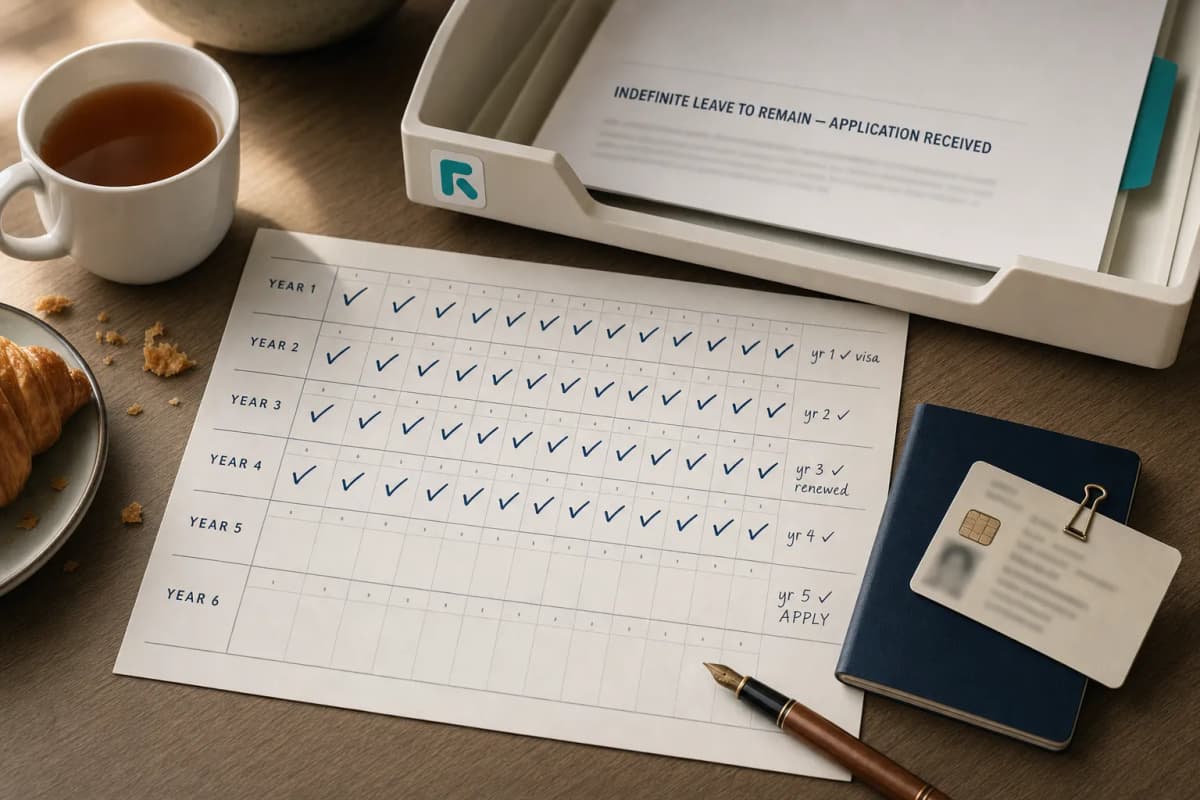
Years 0–1.5: language, the ORE, GDC registration (at ~18 months, the fastest licence among the destinations). Years 1.5–2: PLVE and Performer Number, a job offer, the Health and Care visa. From that point the settlement clock runs: about five years to ILR under Earned Settlement, ten under the standard route — plus a year to citizenship in either case.
The practical message: the speed of the UK licence is real; what has lengthened is the passport. If your priority is high income and a fast start, the UK remains the strongest play; if it is the quickest passport for your family, weigh Australia (4–6 years) and Germany (about 5 years' residence, dual citizenship accepted) in the country comparison.
Three things to do today for tomorrow's file
If the UK is your choice, three habits strengthen your Earned Settlement scenario from now: First, a continuous professional paper trail — archive contracts, payslips, and tax records (P60s) from year one; the priority framework is built around documented contribution. Second, NHS-centred roles in the early years — they make your "healthcare worker" identity concrete, and the Performer Number is its proof. Third, watch for the final Home Office guidance — the specifics (exact year, evidence, dependants' position) will be settled there; defer irreversible decisions (like declining another country's offer) until it lands.
And one note on the visa itself: the IHS exemption on the Health and Care visa is worth thousands of pounds to a multi-person family over several years — when comparing job offers, an employer who sponsors this visa is effectively offering a bigger package.
Frequently asked questions
Do PLVE and NHS years count toward settlement? Yes — years on a valid work visa (Skilled/Health and Care) are the core of the qualifying period; student and visitor time generally is not.
What if there is a gap between employers? Short gaps are manageable within the visa rules but must be actively managed; unemployment without a valid visa breaks continuity.
Dual citizenship? The UK accepts it; what happens to your original passport is a matter for your home country's law, not Britain's.
Does my family reach ILR with me? Dependants track their own residence alongside the main applicant; how Earned Settlement treats them will be fixed in the same forthcoming guidance — anchor the family plan to its final text.
The complete UK route, exam to visa, in our UK guide.
About this article. RxApply is an independent education provider. It is not affiliated with, approved, endorsed by, or connected to GDC or the UK Home Office. This is general information, not immigration advice. Consult a licensed immigration adviser for your own case.