

Every published AFK sitting, the registration window that opens months before it, and the reason the closing date is not the date that decides whether you sit.
The National Dental Examining Board of Canada publishes its examination dates roughly a year ahead, and the Assessment of Fundamental Knowledge runs twice a year — February and August. That much is stable enough to plan around. What candidates tend to write in a calendar, though, is the exam day: 5 February 2027, and nothing else.
That is the least useful of the three dates each sitting carries. A sitting is a registration opening time, a registration deadline, and an exam day — and for the February 2027 AFK, NDEB has already moved one of them. A notice currently sits at the top of both the AFK page and the examination dates page: the registration opening dates for the February 2027 AFK have changed, and registration now opens on 15 September for North America and 22 September for Australia and New Zealand. Dates published a year ahead are not dates carved in stone.
What are the AFK exam dates for 2027?
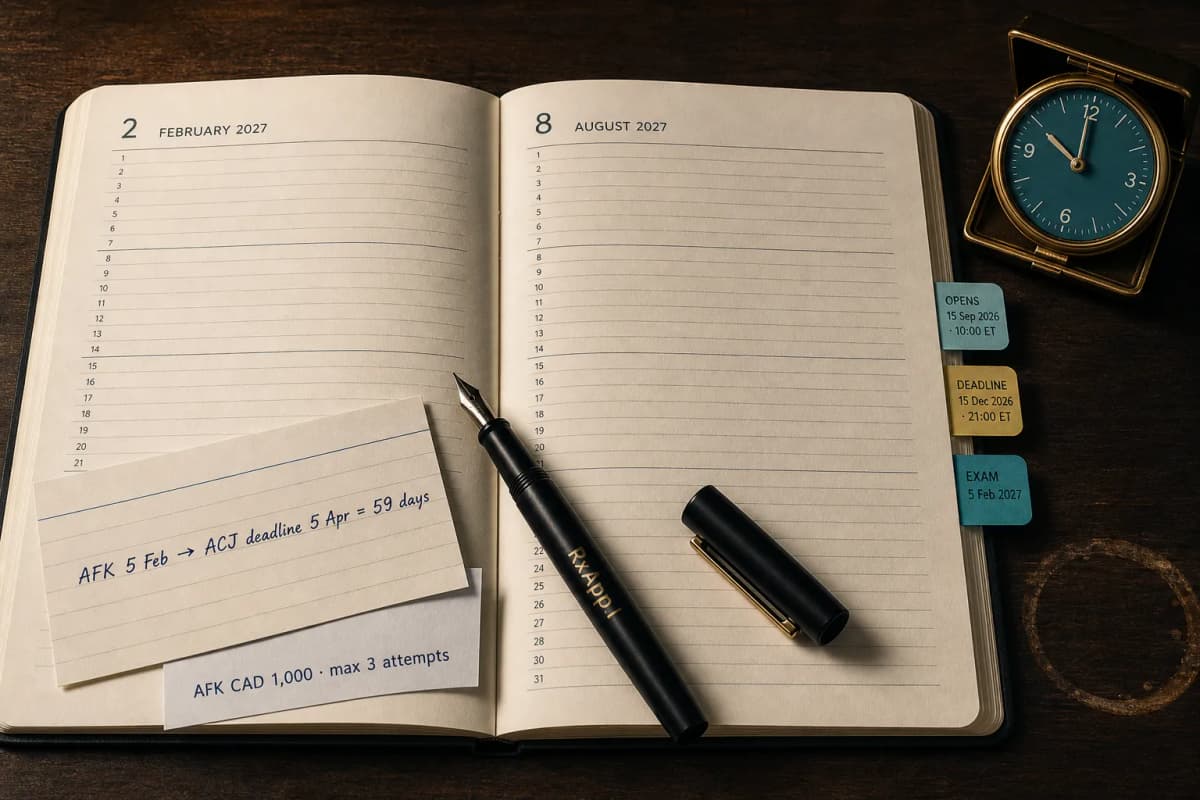
NDEB has published three AFK sittings. In February 2027 the exam is held on 5 February 2027 in Canada and 6 February 2027 in Australia and New Zealand; registration for both closes on 15 December 2026 at 21:00 ET, and opens on 15 September 2026 at 10:00 ET for Canada and 22 September 2026 at 10:00 ET for Australia and New Zealand. In August 2027, NDEB lists a Canada sitting on 13 August 2027, with registration opening 2 March 2027 at 10:00 ET and closing 28 June 2027 at 21:00 ET. No Australia or New Zealand sitting is listed for August 2027, and no 2028 dates have been published yet. The AFK fee is CAD 1,000, and the AFK may be taken a maximum of three times. Source: NDEB, Examination Dates and Locations and Fees; retrieved 17 August 2026.
Last reviewed: 17 August 2026. Next review: 16 September 2026, the day after February registration opens for Canada. Further checkpoints: 16 December 2026, once the February window has closed, and 3 March 2027, after the August window opens. This is dated material — NDEB states that examination dates are normally established one year in advance and are subject to change, so confirm against ndeb-bned.ca before committing money or travel.
The published calendar: three dates per sitting
| Sitting | Registration opens | Registration deadline | Exam day |
|---|---|---|---|
| February 2027 · Canada | 15 September 2026, 10:00 ET | 15 December 2026, 21:00 ET | 5 February 2027 |
| February 2027 · Australia & New Zealand | 22 September 2026, 10:00 ET | 15 December 2026, 21:00 ET | 6 February 2027 |
| August 2027 · Canada | 2 March 2027, 10:00 ET | 28 June 2027, 21:00 ET | 13 August 2027 |
Two structural features are worth reading off the table rather than the calendar app. The registration window is long — 91 days for the February Canada sitting, 84 for its Australia and New Zealand twin, 118 days for August — and the gap between the deadline and the exam is short: 52 days in February, 46 days in August. Neither of those numbers is where the pressure actually sits.
The opening time matters more than the closing time
Most candidates treat the registration deadline as the date to beat. NDEB's own guidance says otherwise. On the AFK page, under the question of why a candidate might be unable to register, the Board writes that you can only register when registration is open and if spaces are available, and adds plainly that it is not unusual for examinations to fill up prior to the registration deadline.
Read against the table, that changes which number you diarise. The February 2027 window is open for three months, but the meaningful date is 15 September 2026 at 10:00 ET — or 22 September for Australia and New Zealand — not 15 December. This is also why the two opening dates differ by a week while the deadline is shared: the deadline is administrative, the opening is where the seats are.
The practical version: put the opening time in your calendar converted to your own time zone, and have your payment method working before the window opens rather than during it.
Read the AFK and ACJ calendars together
The AFK is the first of three examinations in the Equivalency Process, and NDEB is explicit that they must be taken in sequential order. So the AFK date that matters most is not really an AFK date at all — it is the distance between your sitting and the next ACJ registration deadline.
The Assessment of Clinical Judgement runs twice a year, in May and November. Laid against the AFK calendar:
| If you sit the AFK on… | The next ACJ is… | Its registration deadline is… | Days between |
|---|---|---|---|
| 5 February 2027 (Canada) | 4 May 2027 | 5 April 2027, 21:00 ET | 59 days |
| 13 August 2027 (Canada) | 2 November 2027 | 4 October 2027, 21:00 ET | 52 days |
That is the whole planning problem in one table. A February AFK candidate has roughly two months for a result to be released and an ACJ registration to be completed. Miss it, and the next ACJ is 2 November 2027 — the sequential structure turns a narrow administrative gap into a six-month wait.
One honest caveat, and it matters: NDEB does not publish an AFK results-release interval on the AFK page, the dates page, or the equivalency results page. So we are not going to tell you whether 59 days is comfortable or tight. What we can tell you is that this is the single date pair worth confirming directly with NDEB before you choose between the February and August sittings, because it is the one that decides whether your next stage is three months away or nine.
A second point falls out of the same two calendars, and it is easy to miss. The 4 May 2027 ACJ is listed for the United States and Canada, and the 2 November 2027 ACJ for Canada. NDEB currently publishes no ACJ sitting in Australia or New Zealand after 10 November 2026. So the 59-day handoff described above belongs to a candidate sitting the AFK in Canada. If you sit the 6 February 2027 AFK at a centre in Australia or New Zealand, the next ACJ listed anywhere is 4 May 2027 in North America — which makes the location of your ACJ, not just its date, part of the same decision.
Before any of these dates: an approved application
There is a date earlier than every date in the table above, and it is not on NDEB's calendar at all. The Board's registration instructions begin from a precondition: once your Equivalency Process application is approved, you can register for the AFK. Registration and payment then happen inside your NDEBConnect account.
The application fee is CAD 900, one-time and non-refundable, separate from the CAD 1,000 exam fee. NDEB does not publish a processing time for application approval on the pages covering fees, dates, or the AFK itself — so if you are targeting the 15 September opening, treat the approval as work that should already be underway rather than something to start when the window opens.
What NDEB has not published yet
Stated plainly, so it is not mistaken for an omission:
- No Australia or New Zealand sitting for August 2027. The February 2027 sitting has a twin on 6 February; the August 2027 listing shows Canada only. If you intend to test outside Canada, February is the confirmed option and August is not yet listed.
- No 2028 AFK dates. Consistent with NDEB's practice of publishing roughly a year ahead.
- No ACJ in Australia or New Zealand after 10 November 2026. Relevant if you plan to sit both written exams outside Canada.
- The 2026 AFK sittings no longer appear. The page carries forthcoming examinations and recently closed registrations, and the 2026 AFK sittings are on neither list, so those dates cannot be verified there now. If you are searching for a 2026 date, the sittings have passed; 5 February 2027 is the next one.
What you are registering for
Briefly, because the dates are the point of this article and the full three-exam picture is elsewhere. The AFK is 200 single-answer multiple-choice questions delivered in two parts, two hours for each part. Scoring is test-equated and re-scaled: 75 or above is a pass, below 75 is a fail, and no further breakdown of results is provided. You may take it a maximum of three times.
Delivery is split. NDEB administers the AFK in paper format at locations in Canada and electronically at Prometric test centres in Canada, Australia and New Zealand; electronic sittings carry "Prometric" in the exam title when you select a delivery method during registration. For electronic exams, scheduling instructions appear in your registration under Documents after the registration deadline — a second short administrative step that candidates routinely forget exists.
On outcomes, NDEB's published 2025 figures: first-time takers passed at 532 of 1,073 — 49.6 percent — and repeat takers at 278 of 476, for a blended rate of 52.29 percent across 1,549 candidates (NDEB, Equivalency Process Exam Results, retrieved 17 August 2026).
Where you are today
The calendar only becomes actionable once you locate yourself on it.
Your application is not yet approved. Your binding date is 15 September 2026, not 15 December — and the work is documentation and approval, not revision.
Your application is approved and you are targeting February 2027. Two calendar entries: the opening time in Eastern Time, and 5 April 2027, the ACJ deadline that your result has to beat.
You are choosing between February and August 2027. The August sitting gives six more months of preparation and a 52-day handoff to the November ACJ. If you test outside Canada, note that August is not yet listed for Australia and New Zealand.
You have already passed the AFK. Your dates are the ACJ ones — 9 and 10 November 2026, then 4 May 2027 — and after that, the Virtual OSCE and provincial registration.
Frequently asked questions
How many times can I sit the AFK?
Three. NDEB states a maximum of three attempts, which is why the choice of sitting carries more weight than a single date usually does.
Can I register for the AFK before my application is approved?
No. NDEB's instructions place registration after approval of your Equivalency Process application.
What does the whole first stage cost?
CAD 900 for the application and CAD 1,000 for the AFK, both from NDEB's fees page; the examination fee table is marked effective 1 July 2025, while the application fee is listed under "Other Fees" with no effective date given. Verification of a score is a further CAD 200. NDEB states that all fees are subject to change.
Where can I sit the AFK?
Paper format at locations in Canada, and electronically at Prometric test centres in Canada, Australia and New Zealand. Available locations are shown when you register, and are subject to capacity.
Official sources: NDEB's Examination Dates and Locations, Assessment of Fundamental Knowledge (AFK), Dates and Locations, Fees and Equivalency Process Exam Results — all dates and fees retrieved 17 August 2026. NDEB may amend the calendar; check the official pages before committing money or travel.
The three exams end to end are in our NDEB overview. To place these dates against your own file, you can book a consultation.
About this article. RxApply is an independent education provider. It is not affiliated with, approved, endorsed by, or connected to the NDEB. Official requirements are published at ndeb-bned.ca. This is general educational information about published licensure processes — not immigration, legal, or professional advice, and not a substitute for a licensed adviser in the destination country.


