

On the German route, language is not "one of the documents" — it is the longest line in your calendar. The repeated experience of candidates is that getting from zero to specialist-exam level takes longer than the bureaucracy itself. This article unpacks the two layers of the language requirement, clears up the most common misunderstanding, and answers the specific problem of candidates inside Iran: the official exam centre is closed.
Layer one: general German at B2
The foundation of your file is a general B2 certificate (CEFR framework) from a recognised provider: Goethe, telc, TestDaF, or ÖSD. It is the entry ticket — for starting the recognition process, for the §16d recognition visa or the Chancenkarte, and for entering the market.
And here is the Iranian wrinkle: the German Language Institute Tehran (DSIT) was closed by the Iranian authorities in August 2024 and remains closed. Official Goethe exams no longer run inside Iran; candidates travel to Istanbul, Tbilisi, Baku, Yerevan, or Dubai to sit them. Budget that trip from the start — and since seats at those centres fill with Iranian candidates from every profession, never leave exam registration to the final month. Classes and preparation can happen online or at home; what requires travel is the official exam itself.
Layer two: the FSP — an exam that rehearses your job
The Fachsprachprüfung Zahnmedizin is the C1-level specialist language exam; its legal basis is the Dentistry Act (ZHG) and the 2014 Health Ministers' Conference resolution that fixed the "C1 specialist on a B2 general base" standard. The exam simulates a working day in roughly 60 minutes and three parts:
- A patient conversation — history-taking and explaining treatment in lay language
- Written documentation — composing the case notes in professional German
- A specialist discussion — presenting the case to a colleague-examiner in scientific vocabulary
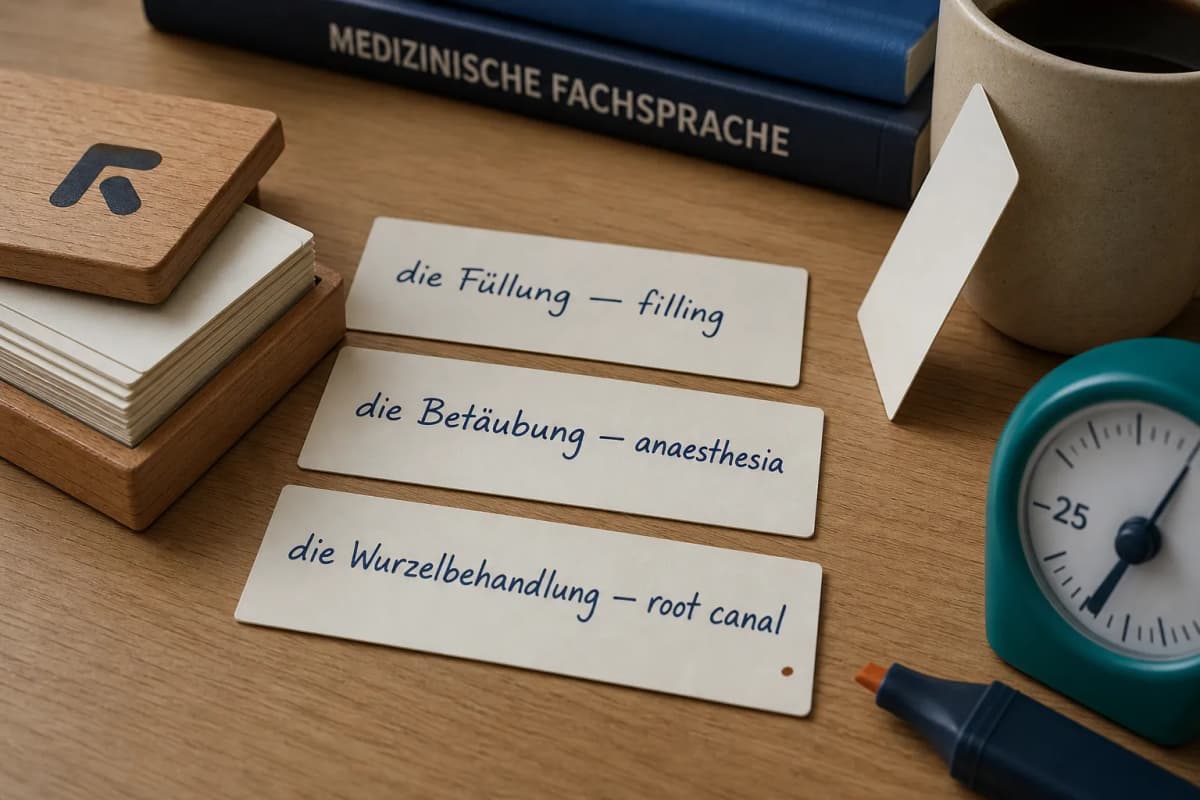
The exam's subtlety lives right there: you must say the same thing in two registers — the patient's language and the colleague's. The actor-patient must understand "root canal" without fear; the examiner must hear the precise clinical account of the same case. Effective FSP practice is practice in that bilingualism, not vocabulary memorisation. Three proven habits of successful candidates: daily spoken run-throughs of history-taking scenarios (with a colleague, or even a voice recorder); one short case note written in German every day; and German clinical teaching videos with key sentences repeated aloud.
Two roads to the FSP: the state chamber, or telc
Road one — the state dental chamber's FSP (LZK): the official exam of the state holding your file; typically €300–500 (a flat €450 in NRW) and usually 4–6 sittings a year.
Road two — telc Deutsch B2-C1 Medizin: the centralised national exam accepted in most states as a full substitute; it runs roughly monthly across German cities and international centres (Budapest among them) and costs €280–450 (typically €330–380 inside Germany).
The 2026 acceptance map: thirteen states accept telc Medizin as a full substitute — Baden-Württemberg, Brandenburg, Bremen, Hesse, Mecklenburg-Vorpommern, Lower Saxony, North Rhine-Westphalia, Rhineland-Palatinate, Saarland, Saxony, Saxony-Anhalt, Schleswig-Holstein, and Thuringia. Berlin and Hamburg prefer their own chamber exams, and Bavaria accepts it partially (it may still require the chamber's oral component). Confirm your target state's rule before registering — and if your state is still undecided, telc is the most "portable" credential across the thirteen.
The practical edge of telc for a candidate abroad: it tests B2 and C1 in one sitting, and its dates are frequent; many consider it the most efficient single exam on the route.
The misunderstanding that delays files
"I have Goethe B2, so I'm ready for the main exam." — No. General B2 without specialist C1 does not complete an Approbation file; and in practice, the gap between B2 and fluent clinical conversation is exactly where optimistic plans break. In most states the FSP is a prerequisite for sitting the Kenntnisprüfung; the correct order of your calendar is: B2 → FSP/telc Medizin → Kenntnisprüfung.
A realistic timeline — and the shortcut that actually works
From zero to B2, with serious sustained study, usually takes 12–18 months; from B2 to FSP readiness, four to eight months of focused clinical practice. The total is most often about two years.
The real shortcut is not compressing the classes; it is changing the environment. Candidates who spend the second half of the language journey inside Germany — on a §16d visa, working under supervision on a Berufserlaubnis — cover the B2-to-FSP distance far faster: eight hours a day of hearing and speaking real clinical German does what no course can. If your life allows it, set your jump point at B2, not at the FSP.
And our standing advice at RxApply is simple: if Germany is seriously on your list, start the language before the other decisions are settled. It is the only line you can advance from home today, with no permit and no paperwork — and the only one that keeps its value even if you later choose another country.
The language budget: numbers to set aside
For the financial plan: official B2 exams (Goethe/telc/ÖSD) plus the trip each sitting requires (Istanbul/Yerevan/Tbilisi); telc B2-C1 Medizin at €280–450; the chamber FSP at €300–500; and the biggest line, the teaching itself — two years of courses whose quality multiplies directly into how many times you sit the exams. The budgeting rule: allow for one language-exam retake, but build the plan for a single pass — the difference between the two lies in the quality of your three-part practice, not in luck.
Frequently asked questions
Does a B2 certificate expire? The certificate itself does not, but some authorities look sceptically at very old ones — and your real skill is tested again at the FSP and the main exam. A long gap between B2 and the next step works against you.
Is the physicians' FSP the same as the dentists'? The structure is similar but the dental content (Zahnmedizin) is its own; telc's exam is the general Medizin version, and each state decides its acceptability for dentistry — hence the state check above.
What if I fail the FSP? Retakes are possible and not a catastrophe — but each costs money and months. The passing pattern: at least two full three-part simulations with feedback before the real sitting.
Where language sits in the whole German route — visa, documents, and exam — in our Germany guide.
About this article. RxApply is an independent education provider. It is not affiliated with, approved, endorsed by, or connected to telc, Goethe-Institut, TestDaF or ÖSD.


