Germany visa dentist16d visa GermanyChancenkarte dentist

German Visas for Dentists: §16d, the Chancenkarte, the Anerkennungspartnerschaft, and the Blue Card (2026)

The four visas that carry the German dental route — the §16d recognition visa, the points-based Opportunity Card, the employer-backed Recognition Partnership, and the EU Blue Card — with conditions, fees, the Yerevan route for Iranian applicants, and a simple selection map.

German Visas for Dentists: §16d, the Chancenkarte, the Anerkennungspartnerschaft, and the Blue Card (2026)

One feature separates the German route from the English-speaking destinations: a large share of the road — the specialist language exam, Kenntnisprüfung preparation, supervised work — practically has to happen inside Germany. So "which visa do I enter on?" is not a side question here; it is the map itself. Germany's skilled-immigration reforms since 2024 have opened four distinct doors for dentists. This article compares all four under 2026 conditions — plus the special route Iranian applicants have used since Tehran's visa section closed.

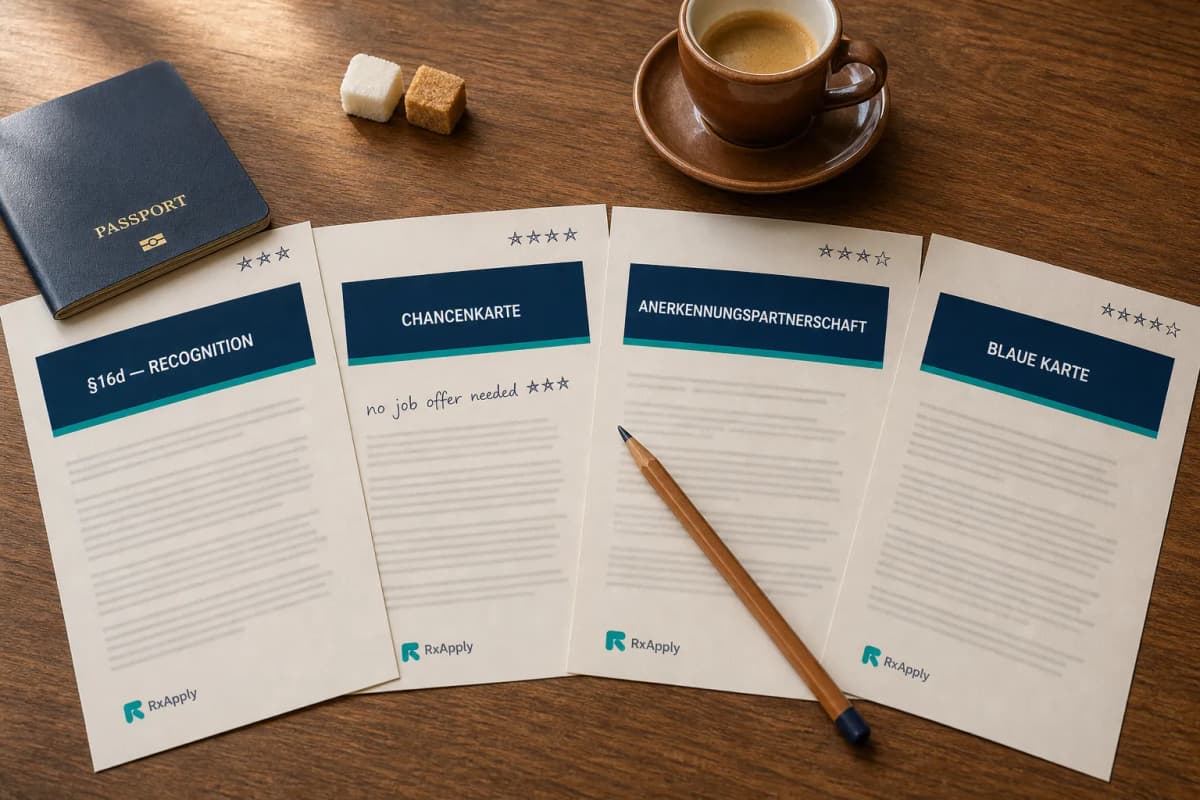
Door one: the recognition visa — §16d

The §16d visa exists precisely so you can complete recognition and the exams on German soil: an initial 18-month stay, extendable to 24, with a €75 government fee. During it you may work within the field in a limited way and — more importantly — practise as a supervised dentist on a Berufserlaubnis (temporary state licence): income and German clinical experience running alongside your Kenntnisprüfung preparation.

Who is it for? The applicant whose German has reached working level (a solid B2) and who wants to enter the execution phase without waiting to land an employer from abroad. It is the dental route's most common visa.

Door two: the Chancenkarte — the Opportunity Card

The Chancenkarte (since June 2024) is the points-based job-seeker visa: 12 months to find an employer, scored on qualifications, experience, age, and language — and dentistry, as a shortage occupation, earns a bonus point. Fee €75–100.

Its place on the map: when your recognition file is not yet ready but you want to assess the market, the cities, and the employers up close; or when your plan is "contract first, everything else after." Its limit is equally clear: twelve months pass, and if the output is not a contract or a status change, you go home. For a candidate with weak German, the Chancenkarte usually becomes an anxious year.

Door three: the Anerkennungspartnerschaft — the Recognition Partnership

The newest tool (March 2024, grounded in §16d Abs. 3) and, in our view, the smartest for anyone who can land an employer from abroad: you enter on a work contract, work full-time on a salary, and the employer commits in writing to support your recognition process. Recognition must start within 6 months of entry; the initial one-year permit extends to a 3-year ceiling; pay must meet local-customary or collective-agreement levels (no fixed minimum).

Why would a German employer sign that? Because practices outside the metros struggle seriously to find dentists, and this instrument makes early hiring legal and attractive. If you can reach a committed employer — through contacts, job platforms, or career fairs — this visa means income from month one plus a three-year recognition window: the most efficient combination on offer.

Door four: the EU Blue Card — for after the Approbation

The Blue Card is not an entry visa to the route; it is the prize at its end. After passing the Kenntnisprüfung and receiving the Approbation, a job offer above the salary threshold — 2026: €50,700 standard, €45,934 for shortage occupations, dentistry included — lets you switch onto the Blue Card. Its core benefit is settlement speed: permanent residence (Niederlassungserlaubnis) after 27 months with B1 German, or just 21 months with B2. For a dentist whose German has reached specialist C1, the B2 condition is trivial — meaning permanent residence less than two years after starting work.
German Visas for Dentists: §16d, the Chancenkarte, the Anerkennungspartnerschaft, and the Blue Card (2026)

The Iranian route in 2026: Tehran closed, Yerevan open

The German embassy in Tehran closed its visa section on 14 February 2026, and Iranian applications have been formally handled by the embassy in Yerevan since May 2026. Early processing reports for Iranian files run slower than baseline — 8–12 weeks for a Chancenkarte against the usual 4–6. Three practical consequences: budget and schedule the Armenia trip; carry a flawless file (every gap is another trip); and complete the document chain before your appointment.

The selection map in three lines

Language ready + a few months' savings → §16d, straight into the German phase. A committed employer found → Anerkennungspartnerschaft; the route's best economics. Still scouting the market → Chancenkarte, only with presentable German. And in every scenario, keep the Blue Card in mind for the day after the Approbation — it is what compresses your permanent-residence clock to 21 months.

A closing reminder: the Approbation alone does not connect you to the statutory-insurance market (about 90 percent of German dentistry); that requires the state chamber's register and KZV admission as a contract dentist. Put that final administrative station in the post-exam plan.

Frequently asked questions

Can family accompany a §16d holder? Family reunification on the 16d is more limited than on work visas and is applied state-by-state, case-by-case; on the Anerkennungspartnerschaft and Blue Card, family accompaniment is standard and smoother. If your family travels with you from day one, weigh that difference in the visa choice.

How many Chancenkarte points do I need, and what does dentistry add? The system scores qualifications, experience, age, and language, with a bonus point for shortage occupations including dentistry; a young dentist with B1/B2 usually clears the threshold without trouble — the real bottleneck is the quality of your plan for those 12 months, not the entry score.

Where do I find an Anerkennungspartnerschaft employer? Three proven channels: German medical job platforms, the diaspora professional network (strongest in the big-community cities), and direct approaches to practices outside the metros with long-running vacancies. A video interview in fluent B2 German is, in effect, your real entrance exam.

What does supervised work pay? Less than a licensed dentist, but a living wage; within an Anerkennungspartnerschaft, pay must meet the local standard. Treat the salary as a side benefit — the period's real value is language acceleration and exam readiness.

What if Yerevan refuses the visa? Refusals come with reasons and appeal/reapplication rights; the commonest causes on Iranian files are document gaps and unclear proof of funds — both preventable with a complete chain and transparent financial records.

The one-glance summary

§16d for a fast start with the language in hand; the Chancenkarte for a year of scouting; the Anerkennungspartnerschaft for salaried entry with a committed employer — the route's best economics; and the Blue Card as the post-Approbation accelerator to permanent residence. The doors combine, and switching between them inside Germany is possible; what cannot be recovered are years lost before starting the language.


The whole German route — language, documents, exam, and work — in our Germany guide.

RxApply

RxApply

German Visas for Dentists: §16d, the Chancenkarte, the Anerkennungspartnerschaft, and the Blue Card (2026)

The four visas that carry the German dental route — the §16d recognition visa, the points-based Opportunity Card, the employer-backed Recognition Partnership, and the EU Blue Card — with conditions, fees, the Yerevan route for Iranian applicants, and a simple selection map.

German Visas for Dentists: §16d, the Chancenkarte, the Anerkennungspartnerschaft, and the Blue Card (2026)

One feature separates the German route from the English-speaking destinations: a large share of the road — the specialist language exam, Kenntnisprüfung preparation, supervised work — practically has to happen inside Germany. So "which visa do I enter on?" is not a side question here; it is the map itself. Germany's skilled-immigration reforms since 2024 have opened four distinct doors for dentists. This article compares all four under 2026 conditions — plus the special route Iranian applicants have used since Tehran's visa section closed.

Door one: the recognition visa — §16d

The §16d visa exists precisely so you can complete recognition and the exams on German soil: an initial 18-month stay, extendable to 24, with a €75 government fee. During it you may work within the field in a limited way and — more importantly — practise as a supervised dentist on a Berufserlaubnis (temporary state licence): income and German clinical experience running alongside your Kenntnisprüfung preparation.

Who is it for? The applicant whose German has reached working level (a solid B2) and who wants to enter the execution phase without waiting to land an employer from abroad. It is the dental route's most common visa.

Door two: the Chancenkarte — the Opportunity Card

The Chancenkarte (since June 2024) is the points-based job-seeker visa: 12 months to find an employer, scored on qualifications, experience, age, and language — and dentistry, as a shortage occupation, earns a bonus point. Fee €75–100.

Its place on the map: when your recognition file is not yet ready but you want to assess the market, the cities, and the employers up close; or when your plan is "contract first, everything else after." Its limit is equally clear: twelve months pass, and if the output is not a contract or a status change, you go home. For a candidate with weak German, the Chancenkarte usually becomes an anxious year.

Door three: the Anerkennungspartnerschaft — the Recognition Partnership

The newest tool (March 2024, grounded in §16d Abs. 3) and, in our view, the smartest for anyone who can land an employer from abroad: you enter on a work contract, work full-time on a salary, and the employer commits in writing to support your recognition process. Recognition must start within 6 months of entry; the initial one-year permit extends to a 3-year ceiling; pay must meet local-customary or collective-agreement levels (no fixed minimum).

Why would a German employer sign that? Because practices outside the metros struggle seriously to find dentists, and this instrument makes early hiring legal and attractive. If you can reach a committed employer — through contacts, job platforms, or career fairs — this visa means income from month one plus a three-year recognition window: the most efficient combination on offer.

Door four: the EU Blue Card — for after the Approbation

The Blue Card is not an entry visa to the route; it is the prize at its end. After passing the Kenntnisprüfung and receiving the Approbation, a job offer above the salary threshold — 2026: €50,700 standard, €45,934 for shortage occupations, dentistry included — lets you switch onto the Blue Card. Its core benefit is settlement speed: permanent residence (Niederlassungserlaubnis) after 27 months with B1 German, or just 21 months with B2. For a dentist whose German has reached specialist C1, the B2 condition is trivial — meaning permanent residence less than two years after starting work.

German Visas for Dentists: §16d, the Chancenkarte, the Anerkennungspartnerschaft, and the Blue Card (2026)

The Iranian route in 2026: Tehran closed, Yerevan open

The German embassy in Tehran closed its visa section on 14 February 2026, and Iranian applications have been formally handled by the embassy in Yerevan since May 2026. Early processing reports for Iranian files run slower than baseline — 8–12 weeks for a Chancenkarte against the usual 4–6. Three practical consequences: budget and schedule the Armenia trip; carry a flawless file (every gap is another trip); and complete the document chain before your appointment.

The selection map in three lines

Language ready + a few months' savings → §16d, straight into the German phase. A committed employer found → Anerkennungspartnerschaft; the route's best economics. Still scouting the market → Chancenkarte, only with presentable German. And in every scenario, keep the Blue Card in mind for the day after the Approbation — it is what compresses your permanent-residence clock to 21 months.

A closing reminder: the Approbation alone does not connect you to the statutory-insurance market (about 90 percent of German dentistry); that requires the state chamber's register and KZV admission as a contract dentist. Put that final administrative station in the post-exam plan.

Frequently asked questions

Can family accompany a §16d holder? Family reunification on the 16d is more limited than on work visas and is applied state-by-state, case-by-case; on the Anerkennungspartnerschaft and Blue Card, family accompaniment is standard and smoother. If your family travels with you from day one, weigh that difference in the visa choice.

How many Chancenkarte points do I need, and what does dentistry add? The system scores qualifications, experience, age, and language, with a bonus point for shortage occupations including dentistry; a young dentist with B1/B2 usually clears the threshold without trouble — the real bottleneck is the quality of your plan for those 12 months, not the entry score.

Where do I find an Anerkennungspartnerschaft employer? Three proven channels: German medical job platforms, the diaspora professional network (strongest in the big-community cities), and direct approaches to practices outside the metros with long-running vacancies. A video interview in fluent B2 German is, in effect, your real entrance exam.

What does supervised work pay? Less than a licensed dentist, but a living wage; within an Anerkennungspartnerschaft, pay must meet the local standard. Treat the salary as a side benefit — the period's real value is language acceleration and exam readiness.

What if Yerevan refuses the visa? Refusals come with reasons and appeal/reapplication rights; the commonest causes on Iranian files are document gaps and unclear proof of funds — both preventable with a complete chain and transparent financial records.

The one-glance summary

§16d for a fast start with the language in hand; the Chancenkarte for a year of scouting; the Anerkennungspartnerschaft for salaried entry with a committed employer — the route's best economics; and the Blue Card as the post-Approbation accelerator to permanent residence. The doors combine, and switching between them inside Germany is possible; what cannot be recovered are years lost before starting the language.


The whole German route — language, documents, exam, and work — in our Germany guide.

RxApply

About the author

RxApply

The RxApply editorial team — coaches, alumni, and operations — writes field notes from the cohort. Each article lists the coach who lived the path it describes.

Related field notes

More from the blog.

Curated by coaches. Read in order if you’re starting from zero.

All field notes
RxApply