best country for dentist migrationcountry comparison for dentistsdentist immigration 2026

The Best Country for Dentist Migration in 2026: A Fair Five-Way Comparison

Australia, Canada, the UK, Germany, and the US side by side on six criteria: cost, time, language, accessibility, income, and the residency horizon — with 2026 figures, candidate profiles, and no favouritism.

The Best Country for Dentist Migration in 2026: A Fair Five-Way Comparison

"Which country is best?" — the question we hear most, and the only honest answer is: it depends on what you are willing to pay and what you refuse to negotiate. What we can do is lay five destinations on one table with identical criteria; the choice is yours.

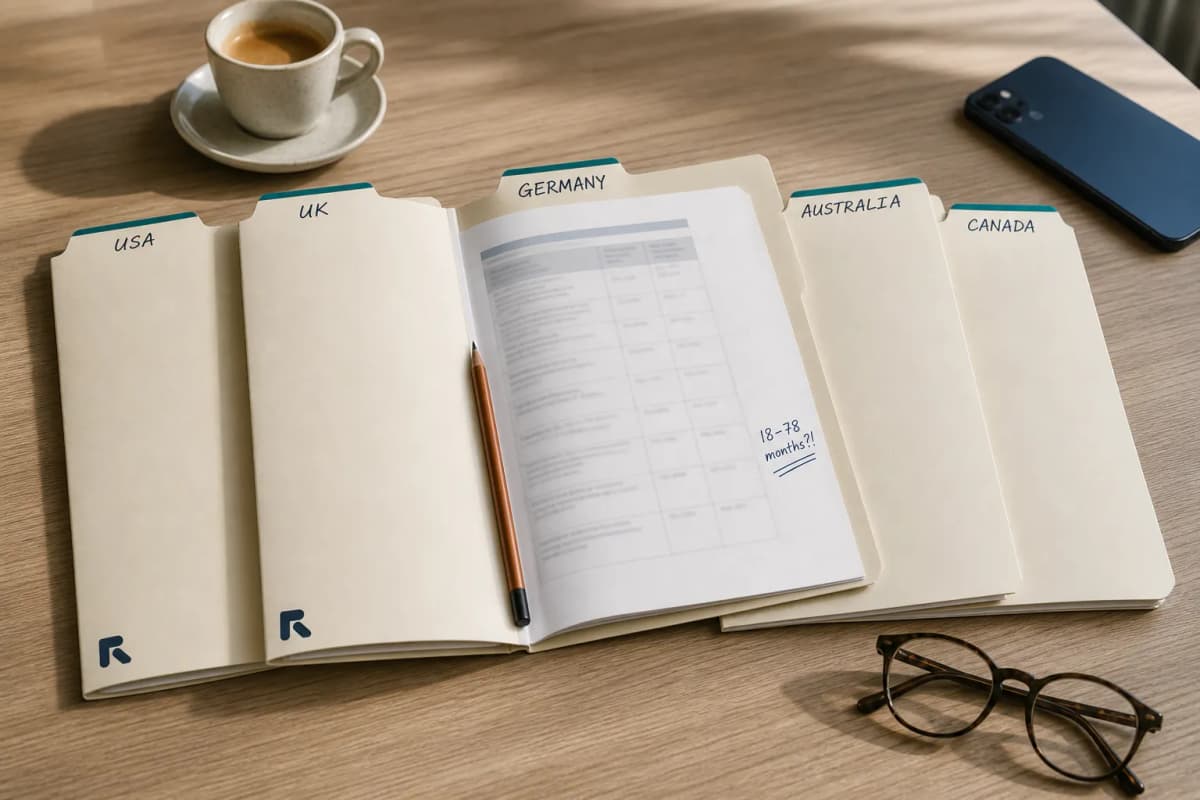
The 2026 picture at a glance

Criterion Australia Canada UK Germany USA
Regulator ADC + AHPRA NDEB + provinces GDC State authorities (ZApprO) 50 state boards
Typical total cost AUD 20–30k CAD 35–65k £25–45k €20–50k USD 200–400k
Time to licence 18–48 mo 24–72 mo 18–36 mo 24–60 mo 30–78 mo
Language 4 accepted tests (AHPRA) English/French Strict IELTS 7.0 German B2 + specialist C1 English (TOEFL)
Startable from home Yes — fully Yes — first two exams Largely Language and documents Exams yes; visas suspended for Iranians
Typical GP income High; higher regionally CAD 170–280k £75–150k Mid-European + Versorgungswerk Highest ceiling
Arrival to passport 4–6 yrs 6–8 yrs 6–11 yrs (two scenarios) ~5 yrs residence Currently blocked for Iranians (PP 10998)

(The figures are documented typical ranges as of June 2026; individual files can fall outside them.)

Australia: the most accessible of 2026

The cheapest route (AUD 20–30k), direct acceptance of certified Iranian translations (and no notarisation since 2025), the written exam available in Dubai and Istanbul, four accepted English tests including the OET with a Tehran centre, and the fastest passport (4–6 years). The price: a practical exam passing 10–15 percent that runs only in Melbourne, and in 2026 a temporary entry suspension for Iranian visitor-visa holders (skilled visas exempt). For the dentist confident in their hands who values the passport, it is this year's strongest play.

Canada: the most predictable

The only major destination whose first two exams can be fully started from home with no status; a transparent parallel immigration rail (Express Entry NOC 31110 with dedicated healthcare draws); a deep market with incomes of CAD 170–280k; and official shortcuts (the BTDPC and QP) for residents. The price: the longest total route (24–72 months), middle-of-pack costs (CAD 35–65k), and the NDECC bottleneck with its 40.6 percent clinical pass rate. For families who want an orderly multi-year plan, it is the most rational choice.

The UK: fastest licence, highest income — longest passport

About 18 months to GDC registration in the optimistic case, income of £75–150k, noticeably expanded ORE capacity from 2026 (2,400 Part 1 seats) plus the LDS alternative. The price: strict IELTS (7.0 overall, in-person Academic only), costs above Australia and Germany, and April 2026's big change — the standard settlement period is now 10 years, though dentists are natural candidates for the faster Earned Settlement track (the full analysis). For those whose priority is fast work and income rather than a fast passport, it is the best option.
The Best Country for Dentist Migration in 2026: A Fair Five-Way Comparison

Germany: low-cost for the patient — if the language is yours

Low official costs (€20–50k), a standardised Kenntnisprüfung from November 2026, paid supervised work before the exam (Berufserlaubnis), four purpose-built visas including the Blue Card with permanent residence in as little as 21 months, citizenship at 5 years with dual nationality accepted, and Europe's largest Iranian community (250–300k). The price: roughly two years of language to specialist C1, no acceptance of Iranian translations, Tehran's closed visa section (the Yerevan route), and no Goethe testing inside Iran. If German is not a dealbreaker, Germany's cost-to-quality-of-life ratio is Australia's most serious rival.

The US: the richest — behind a door currently closed

The deepest market and the highest income ceiling; but the main route (the IDP) costs a world-leading USD 250–380k, and more decisively: Proclamation 10998 has suspended Iranian student and work visas since January 2026. Green-card holders are exempt; everyone else can keep the file warm while running another active destination.

Five profiles, five answers

Instead of one verdict, find yourself here: Strong hands + passport priority → Australia. Careful planner + family + long horizon → Canada. Fast income + strong English → the UK. Patient + willing to learn German + tight budget → Germany. Green-card holder or US-resident spouse → the US (and only that group). And if you are stuck between two, three deciding questions: German — yes or no? Passport or early income? And how much practical-exam risk can you truly carry?

Frequently asked questions

Can I run two routes at once? Yes — and in 2026 it is recommended (the active-plus-ready pattern). The overlap is real: the document chain is one job; strong English covers three destinations; and the theory exams (AFK, ADC written, INBDE) are intellectual cousins. What needs two versions: credential evaluations (WES/ICAS for Canada, ECE for the US) and the practical exams.

Which destination punishes age 40+ most? Licences have no age limits; age burns points in points-based residency (Canada's Express Entry, Australia's independent routes). Past 40, the employer-backed lanes (the UK's Health and Care visa, Australia's 482, Germany's Anerkennungspartnerschaft) gain weight.

For a family with school-age children, where is the real difference? In all five, children of work-visa holders attend public school; the real differences are the spouse's work rights (granted on the main work visas of all four open destinations) and the length of the uncertainty period — the passport row in the table.

If I later regret the choice, which licences transfer? Honestly: none automatically. Every country runs its own system (even Britain's LDS is not accepted in Australia). What does transfer: experience in a Western system, language, and capital — which make the second file far faster.

Lowest overall risk for an average file? Canada as the main route (home-startable, residency in parallel) with Australia as the hands-on alternative; or the reverse for those with exceptional practical skills. Germany joins that equation only with a genuine language commitment.

The last word

This comparison is not for choosing the world's best country; it is for choosing the best country for your file — and that choice starts with three honest questions to yourself, not with Instagram statistics. Once you have the answers, read the full guide for that destination and start the document checklist this week: on all five routes, the first step is the same.


The full guide for each destination: AustraliaCanadaUKGermanyUSA

RxApply

RxApply

The Best Country for Dentist Migration in 2026: A Fair Five-Way Comparison

Australia, Canada, the UK, Germany, and the US side by side on six criteria: cost, time, language, accessibility, income, and the residency horizon — with 2026 figures, candidate profiles, and no favouritism.

The Best Country for Dentist Migration in 2026: A Fair Five-Way Comparison

"Which country is best?" — the question we hear most, and the only honest answer is: it depends on what you are willing to pay and what you refuse to negotiate. What we can do is lay five destinations on one table with identical criteria; the choice is yours.

The 2026 picture at a glance

Criterion Australia Canada UK Germany USA
Regulator ADC + AHPRA NDEB + provinces GDC State authorities (ZApprO) 50 state boards
Typical total cost AUD 20–30k CAD 35–65k £25–45k €20–50k USD 200–400k
Time to licence 18–48 mo 24–72 mo 18–36 mo 24–60 mo 30–78 mo
Language 4 accepted tests (AHPRA) English/French Strict IELTS 7.0 German B2 + specialist C1 English (TOEFL)
Startable from home Yes — fully Yes — first two exams Largely Language and documents Exams yes; visas suspended for Iranians
Typical GP income High; higher regionally CAD 170–280k £75–150k Mid-European + Versorgungswerk Highest ceiling
Arrival to passport 4–6 yrs 6–8 yrs 6–11 yrs (two scenarios) ~5 yrs residence Currently blocked for Iranians (PP 10998)

(The figures are documented typical ranges as of June 2026; individual files can fall outside them.)

Australia: the most accessible of 2026

The cheapest route (AUD 20–30k), direct acceptance of certified Iranian translations (and no notarisation since 2025), the written exam available in Dubai and Istanbul, four accepted English tests including the OET with a Tehran centre, and the fastest passport (4–6 years). The price: a practical exam passing 10–15 percent that runs only in Melbourne, and in 2026 a temporary entry suspension for Iranian visitor-visa holders (skilled visas exempt). For the dentist confident in their hands who values the passport, it is this year's strongest play.

Canada: the most predictable

The only major destination whose first two exams can be fully started from home with no status; a transparent parallel immigration rail (Express Entry NOC 31110 with dedicated healthcare draws); a deep market with incomes of CAD 170–280k; and official shortcuts (the BTDPC and QP) for residents. The price: the longest total route (24–72 months), middle-of-pack costs (CAD 35–65k), and the NDECC bottleneck with its 40.6 percent clinical pass rate. For families who want an orderly multi-year plan, it is the most rational choice.

The UK: fastest licence, highest income — longest passport

About 18 months to GDC registration in the optimistic case, income of £75–150k, noticeably expanded ORE capacity from 2026 (2,400 Part 1 seats) plus the LDS alternative. The price: strict IELTS (7.0 overall, in-person Academic only), costs above Australia and Germany, and April 2026's big change — the standard settlement period is now 10 years, though dentists are natural candidates for the faster Earned Settlement track (the full analysis). For those whose priority is fast work and income rather than a fast passport, it is the best option.

The Best Country for Dentist Migration in 2026: A Fair Five-Way Comparison

Germany: low-cost for the patient — if the language is yours

Low official costs (€20–50k), a standardised Kenntnisprüfung from November 2026, paid supervised work before the exam (Berufserlaubnis), four purpose-built visas including the Blue Card with permanent residence in as little as 21 months, citizenship at 5 years with dual nationality accepted, and Europe's largest Iranian community (250–300k). The price: roughly two years of language to specialist C1, no acceptance of Iranian translations, Tehran's closed visa section (the Yerevan route), and no Goethe testing inside Iran. If German is not a dealbreaker, Germany's cost-to-quality-of-life ratio is Australia's most serious rival.

The US: the richest — behind a door currently closed

The deepest market and the highest income ceiling; but the main route (the IDP) costs a world-leading USD 250–380k, and more decisively: Proclamation 10998 has suspended Iranian student and work visas since January 2026. Green-card holders are exempt; everyone else can keep the file warm while running another active destination.

Five profiles, five answers

Instead of one verdict, find yourself here: Strong hands + passport priority → Australia. Careful planner + family + long horizon → Canada. Fast income + strong English → the UK. Patient + willing to learn German + tight budget → Germany. Green-card holder or US-resident spouse → the US (and only that group). And if you are stuck between two, three deciding questions: German — yes or no? Passport or early income? And how much practical-exam risk can you truly carry?

Frequently asked questions

Can I run two routes at once? Yes — and in 2026 it is recommended (the active-plus-ready pattern). The overlap is real: the document chain is one job; strong English covers three destinations; and the theory exams (AFK, ADC written, INBDE) are intellectual cousins. What needs two versions: credential evaluations (WES/ICAS for Canada, ECE for the US) and the practical exams.

Which destination punishes age 40+ most? Licences have no age limits; age burns points in points-based residency (Canada's Express Entry, Australia's independent routes). Past 40, the employer-backed lanes (the UK's Health and Care visa, Australia's 482, Germany's Anerkennungspartnerschaft) gain weight.

For a family with school-age children, where is the real difference? In all five, children of work-visa holders attend public school; the real differences are the spouse's work rights (granted on the main work visas of all four open destinations) and the length of the uncertainty period — the passport row in the table.

If I later regret the choice, which licences transfer? Honestly: none automatically. Every country runs its own system (even Britain's LDS is not accepted in Australia). What does transfer: experience in a Western system, language, and capital — which make the second file far faster.

Lowest overall risk for an average file? Canada as the main route (home-startable, residency in parallel) with Australia as the hands-on alternative; or the reverse for those with exceptional practical skills. Germany joins that equation only with a genuine language commitment.

The last word

This comparison is not for choosing the world's best country; it is for choosing the best country for your file — and that choice starts with three honest questions to yourself, not with Instagram statistics. Once you have the answers, read the full guide for that destination and start the document checklist this week: on all five routes, the first step is the same.


The full guide for each destination: AustraliaCanadaUKGermanyUSA

RxApply

About the author

RxApply

The RxApply editorial team — coaches, alumni, and operations — writes field notes from the cohort. Each article lists the coach who lived the path it describes.

Related field notes

More from the blog.

Curated by coaches. Read in order if you’re starting from zero.

All field notes
RxApply