
RxApply is an independent education provider. It is not affiliated with, approved, endorsed by, or connected to the Australian Dental Council, Pearson or Ahpra. Everything below comes from the ADC's and Pearson's own published material, linked and dated.
Most advice about the ADC written examination is written by people selling preparation for it. Very little of it starts where the examiner starts: with the blueprint the Australian Dental Council publishes, which states the exact percentage of the paper given to every domain and every discipline.
This article covers what the written examination measures, the two-step timeline that gets you into a seat, the study material the ADC itself publishes, one reasonable way to structure six months of work, and what the published pass rates do and do not mean. It contains no examination questions and no recalled content, which is deliberate — that is explained below.
How do you prepare for the ADC written exam?
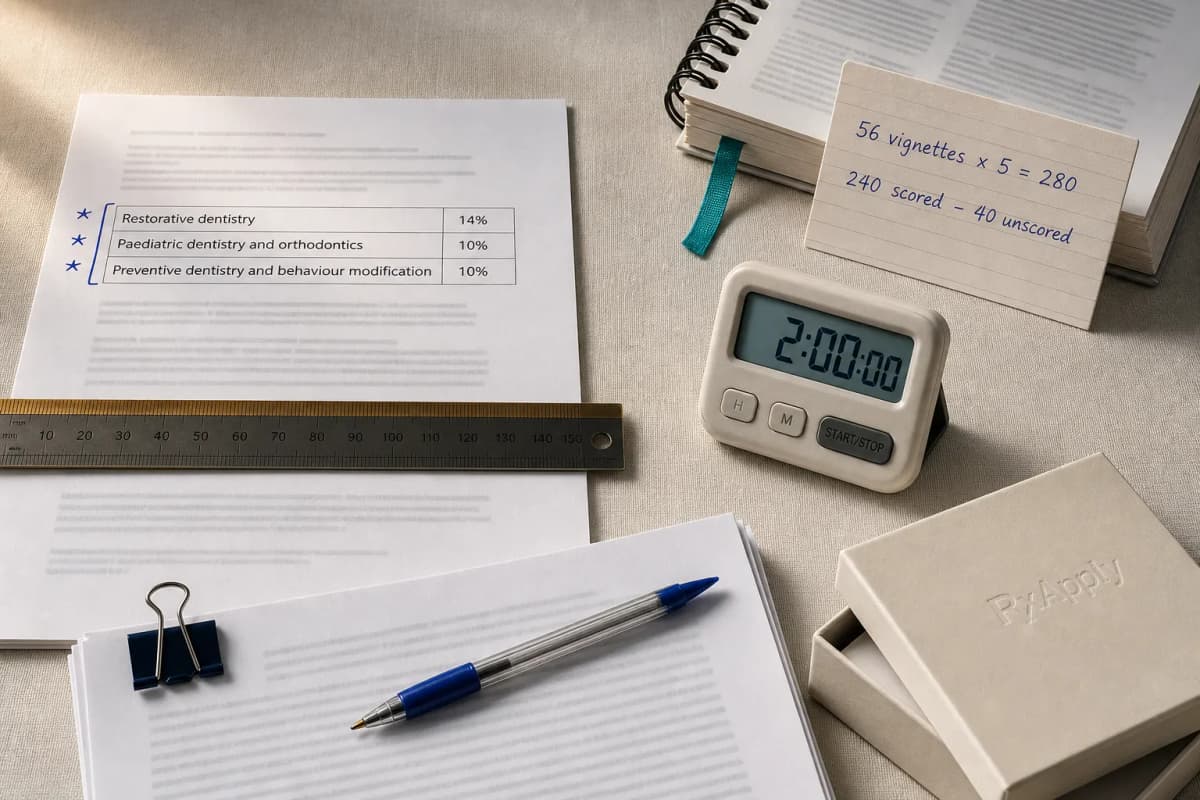
Preparation begins with the ADC's published blueprint, because the ADC states in advance what the paper will contain. The written examination is 280 scenario-based multiple-choice questions across four two-hour sections, sat over two consecutive days at a Pearson test centre; 240 questions are scored and 40 are unscored calibration items. Questions are grouped into four clusters, and you must pass every cluster separately: professionalism and health promotion (20% of the paper combined), clinical information gathering (30%), diagnosis and management planning (30%), and clinical treatment and evaluation (20%). By discipline, restorative dentistry is the largest single block at 14%, then paediatric dentistry and orthodontics and preventive dentistry at 10% each. The ADC publishes a handbook, a free practice paper of retired questions and a reading list, and states that it does not endorse any preparation course.
Source: the ADC Written Examination Handbook for General Dentistry (Rev E, September 2025) and the ADC written examination page, both verified 4 September 2026.
The exam at a glance
| Stage | Stage 2 of 3 in the ADC dentist assessment process, after the initial assessment and before the practical examination |
|---|---|
| Format | Computer-delivered scenario-based multiple-choice, at Pearson test centres |
| Structure | Four sections of 70 questions; two hours per section; two sections each day |
| Total questions | 280 — of which 240 are scored and 40 are unscored |
| Scenarios | 56 clinical vignettes, each carrying five single-best-answer questions |
| Days | Two consecutive days, same venue both days, one examination session |
| Delivery and booking | Pearson VUE; booking opens on an Authorisation to Test email, roughly a two-week window, limited venues allocated first come, first served |
| Passing requirement | A pass in each of the four clusters; no published pass mark, set by standard setting against a recent Australian graduate |
| Next sittings | 16–17 September 2026 · 17–18 March 2027 · 8–9 September 2027 |
| Results | Approximately six weeks after the examination, via ADC Connect |
| Validity of a pass | Five years for passes sat from March 2026 onward; three years for passes up to and including 2025 |
| Attempts | Unlimited, subject to holding a valid initial assessment |
| Application fee | AUD 2,122 |
ADC written examination page and Written Examination Handbook (Rev E, September 2025), with the Pearson ADC page; all verified 4 September 2026.
What the exam actually measures
The ADC builds the paper against the competencies expected of a dentist newly graduating from an ADC-accredited Australian program. The handbook says the format is designed to show that you "know how" to practise dentistry in Australia — knowledge of the science and practice of dentistry, plus clinical judgement and reasoning.
That intention is visible in the item format. The ADC does not use standalone recall questions. It uses what the handbook calls "an overarching clinical vignette, with five multiple choice questions attached", each with a single best answer, each tied to the information in that vignette. Across 280 questions that means 56 scenarios. The practical consequence is that you read a case once and then make five decisions inside it: what else you would ask or examine, what the diagnosis is, what you would do, and why. Rote factual recall gets you into a scenario and no further.
The blueprint states the target weighting in two directions at once — by domain (the clusters you must each pass) and by discipline.
| Domain cluster | Target % of questions |
|---|---|
| Social responsibility & professionalism | 12% |
| Health promotion | 8% |
| Clinical information gathering | 30% |
| Diagnosis and management planning | 30% |
| Clinical treatment and evaluation | 20% |
By discipline, the published targets are: restorative dentistry 14%; paediatric dentistry and orthodontics 10%; preventive dentistry and behaviour modification 10%; periodontics 9%; dental emergencies 8%; general medicine, including medical emergencies and special needs dentistry, 8%; endodontics 7%; oral medicine and pathology 7%; oral surgery 7%; fixed prosthodontics 5%; infection prevention and control 5%; pain and anxiety management 5%; removable prosthodontics 5%. Three subdisciplines are assessed across several of those: pharmacology 10%, radiology 10% and implantology 4%.
Every figure in this section is the ADC's own published target, from Table 1 of the Written Examination Handbook for General Dentistry, Rev E, September 2025 — retrieved 4 September 2026.
One caution when you read the blueprint yourself: the graphic summarising the examination format lists "280 scored questions" and "40 unscored questions", while the handbook text says the paper is 280 questions in total, of which 240 are scored. The body text is the internally consistent one — four sections of 70 is 280.
The two-step timeline
Candidates routinely conflate two separate deadlines. Eligibility and application are different events, months apart.
Your initial assessment must be complete and valid, with an expiry date later than the examination date, by that period's initial assessment deadline. Later — for the September 2027 sitting, six months later — a short application period opens, and a written examination application link appears on your ADC Connect profile. You apply and pay inside that window. In the weeks after a successful application, Pearson sends an Authorisation to Test email, which opens a booking window of roughly two weeks in which you choose your venue. You must book the same venue for both days. Some venues have limited capacity and seats are allocated in order of receipt, and the ADC notes that candidates may need to travel outside their home country to sit.
| Period | Initial assessment deadline | Application period | Examination |
|---|---|---|---|
| 2026 · Period 2 | 12 April 2026 | 9–16 June 2026 | Wed 16 – Thu 17 September 2026 |
| 2027 · Period 1 | 11 October 2026 | 8–15 December 2026 | Wed 17 – Thu 18 March 2027 |
| 2027 · Period 2 | 11 April 2027 | 8–15 June 2027 | Wed 8 – Thu 9 September 2027 |
Two rules are worth knowing before you plan travel. A booking cannot be moved to a later sitting: if you cannot attend, you withdraw and apply again, at the full fee. And the ADC counts an inability to obtain a visa, or a failure to arrange travel, as a withdrawal like any other. We set both calendars — written and practical — against each other in the 2027 ADC calendar guide, and visa timing for Australia in our guide to Australian visas for dentists.
The official study material — all of it
The ADC publishes more preparation material than most candidates realise, and it says plainly that it stands behind none of the alternatives: "We do not recommend or endorse any proprietary or informal courses advertising as preparation for the written examination." Its own material is free, and it is on one page.
- Written Examination Handbook for General Dentistry (Rev E, September 2025) — the blueprint, the cluster grading system, the identification rules, the conduct and withdrawal policies.
- ADC Written Examination Practice Paper (2026) — a 106-page booklet of clinical scenarios drawn from questions retired from the ADC's item bank, which the ADC states will not be used again. These are ADC-authored items in the examination's real format, published by the ADC itself and free to download.
- ADC Examination Resource List — journals and current guideline references. The ADC is candid here that no narrow reading list exists, because the examination draws on the same broad literature Australian practitioners use.
- Seven ADC context resource sheets — cultural safety, at-risk populations, rural and remote communities, social responsibility, intellectual disability, domestic and family violence, and interprofessional collaborative practice. These are easy to skim past, and they map onto the fifth of the paper that internationally trained candidates are least likely to have met in their own training.
- The Professional Competencies of the Newly Qualified Dental Practitioner — the document the blueprint is built from.
- Candidate Rules Agreement, the Pearson ADC page, and Pearson's own guidance on what to expect in the test centre, which is worth ten minutes so the interface is not new on the day.
- The Candidate Lounge newsletter and the ADC's Candidate Forum videos, where changes are announced first.
A word on what is not on that list. Sites and groups circulating "recalled" or remembered questions are not a shortcut; they sit against the candidate rules agreement you sign at registration, and the ADC's misconduct policy applies to your result. RxApply does not use, share or link to that material, and this article reproduces no examination content.
How to study for the ADC exam: one workable structure
This is one reasonable approach, not a formula, and nothing here changes your odds by itself. Work backwards from the sitting date. The application window closes roughly three months before you sit, so a candidate applying in December 2026 for the March 2027 paper has had the dates for a year and has about six months of usable study once the seat is confirmed.
Months 1–2: cover the weight. Sixty per cent of the paper sits in two clusters — clinical information gathering, and diagnosis and management planning. Read for decisions rather than facts: what history and investigations change the answer, and what the reasoning is between findings and a plan. Give the heaviest disciplines their share of the time: restorative, paediatric and orthodontics, preventive, periodontics.
Month 3: the Australian layer. Cluster 1 is a fifth of the paper and is the part least transferable from training elsewhere — professionalism, consent, health promotion, cultural safety, at-risk and rural populations, working with other professions. The ADC's seven resource sheets exist precisely for this, and current Australian guidelines matter more here than any textbook.
Months 4–5: practise in the exam's shape. Two hours, seventy questions, roughly 1.7 minutes each — but read that as 14 vignettes rather than 70 items, because you read the case once and answer five. Practise holding a scenario in your head without notes: no scrap paper and no calculator are permitted in the test centre.
Final month: full sections, then logistics. Sit complete two-hour blocks at the time of day you will actually sit them, and rehearse the two-day rhythm at least once. Then deal with everything that is not clinical — identification that exactly matches your booking name, travel and any visa lead time, and the venue itself. Arrival times are typically at least 45 minutes before the start, and late entry is not granted for any reason.
What the pass rates do and do not tell you
The ADC publishes results in its annual report. Across six years the written examination pass rate ran 50%, 44%, 24%, 24%, 41% and 12% for FY2020 through FY2025 — the six-year table in the ADC Annual Report 2024/25, published 2025 and retrieved 4 September 2026.
Two things follow. First, the series is volatile rather than declining from a settled level: the 41% of FY2024 was itself a spike after two consecutive years at 24%. Second, and more usefully, the absolute numbers carry the FY2025 story better than the percentage does — candidates rose from 2,925 to 3,325 while passes fell from 1,209 to 404.
What none of these figures are is a first-attempt rate. Each is passes divided by everyone who sat that year, repeat candidates included, and the ADC does not publish a first-attempt breakdown. Any source quoting 12% as your chance on a first attempt has added a precision the ADC never claimed. The equivalent picture for the next stage is in our analysis of the ADC practical examination pass rate.
If you are resident in Iran
One access rule now sits in front of preparation. From 12:00 a.m. EDT on 8 September 2026, following the US Treasury's suspension of General License G, Pearson states it cannot schedule or deliver examinations for candidates who are residents of Iran unless they can provide proof of primary residency outside Iran, and that examinations already scheduled for affected candidates will be cancelled. The ADC written examination is delivered by Pearson, and the notice appears on Pearson's own ADC page.
The distinction that matters is residency, not location on the day. This is not a rule that travelling to a test centre in another country resolves; the same proof-of-residency requirement has long applied to residents of Syria on the same page. The first sitting affected is 16–17 September 2026. Pearson describes the suspension as running until further notice, so it may change; we are tracking it, and the position on the day you apply is the one that governs.
Where this leaves you
The unusual thing about the ADC written examination is how little of it is hidden. The weighting of every discipline, the structure of every item, the grading rule and a booklet of retired questions are all published, for free, by the body that sets the paper. A candidate who studies the blueprint first is not being clever; they are reading the specification rather than guessing at it.
Official sources: the ADC written examination page, the Written Examination Handbook for General Dentistry (Rev E, September 2025), the Handbooks and Materials page, the ADC Annual Report 2024/25, the written examination validity extension notice, the Pearson ADC page and Pearson's notice for residents of Iran. All verified 4 September 2026. The ADC and Pearson may amend any of this; check the official pages before committing money or travel.
The three stages end to end are in the step-by-step ADC guide, and the wider picture in our Australia guide. To place these dates against your own timeline, you can book a consultation.
About this article. RxApply is an independent education provider. It is not affiliated with, approved, endorsed by, or connected to the Australian Dental Council, Pearson or Ahpra, and does not prepare candidates for the ADC examinations. Official requirements are published at adc.org.au. This is general educational information about published licensure processes — not immigration, legal, or professional advice, and not a substitute for a licensed adviser in the destination country.