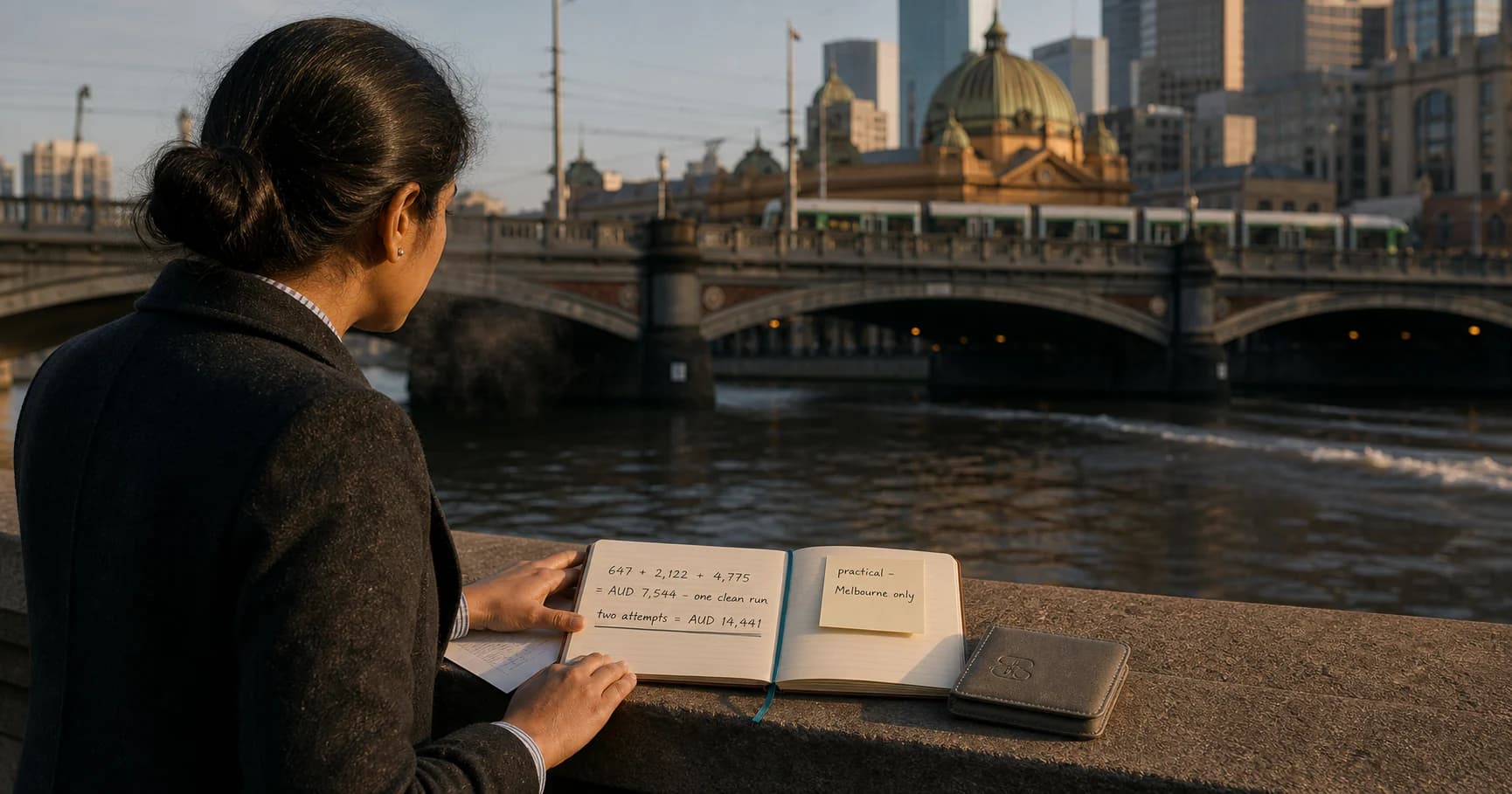
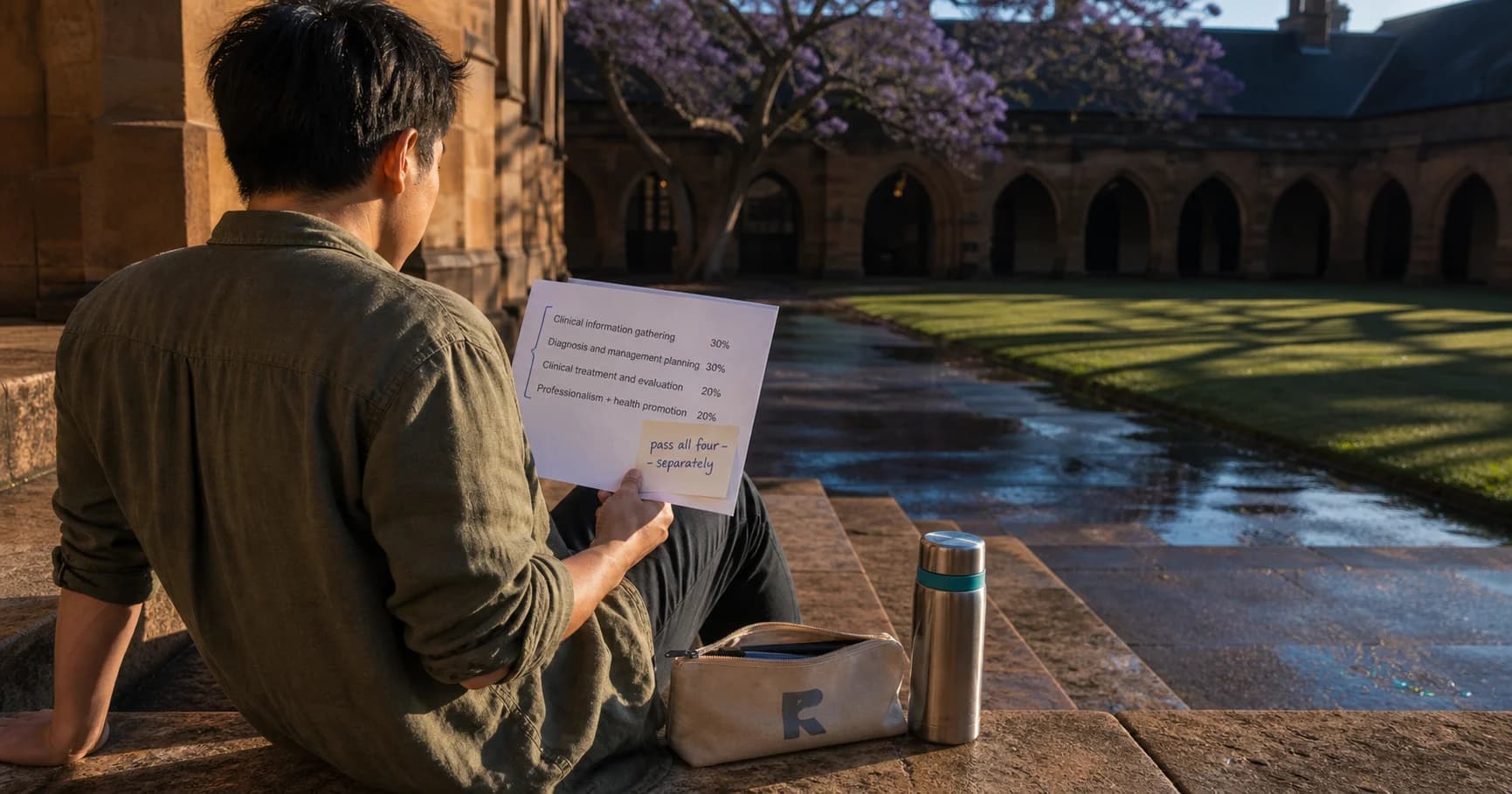
11 percent of candidates who sat the practical examination in FY2025 passed, down from 15 percent the year before — a rate over everyone who sat, not a first-attempt figure, and one measured against a rising cohort: 1,880 candidates, up from 1,703 (ADC Annual Report 2024/25, retrieved 5 August 2026) — the most frightening number on the Australian route. But a number alone doesn't make good decisions; analysis does. This article answers three questions: What exactly does the exam measure? Why do experienced dentists fail it? And what do the passers do differently?
The written examination's FY2025 pass rate was 12 percent (404 of 3,325 candidates) — the lowest in the published series, and the low point of a volatile run rather than a fall from a settled level: 24 percent in FY2022, 24 percent in FY2023, 41 percent in FY2024, then 12 percent in FY2025; the practical examination ran at 15 percent in FY2024.
| Examination | FY2025 pass rate | Passed / sat | FY2024 pass rate |
|---|---|---|---|
| Written | 12% | 404 / 3,325 | 41% |
| Practical | 11% | 205 / 1,880 | 15% |
[ADC Annual Report 2024/25 — retrieved 5 August 2026]
What does the exam actually look like?
The ADC practical runs over two days in exactly one place on earth: the ADC centre in Melbourne.
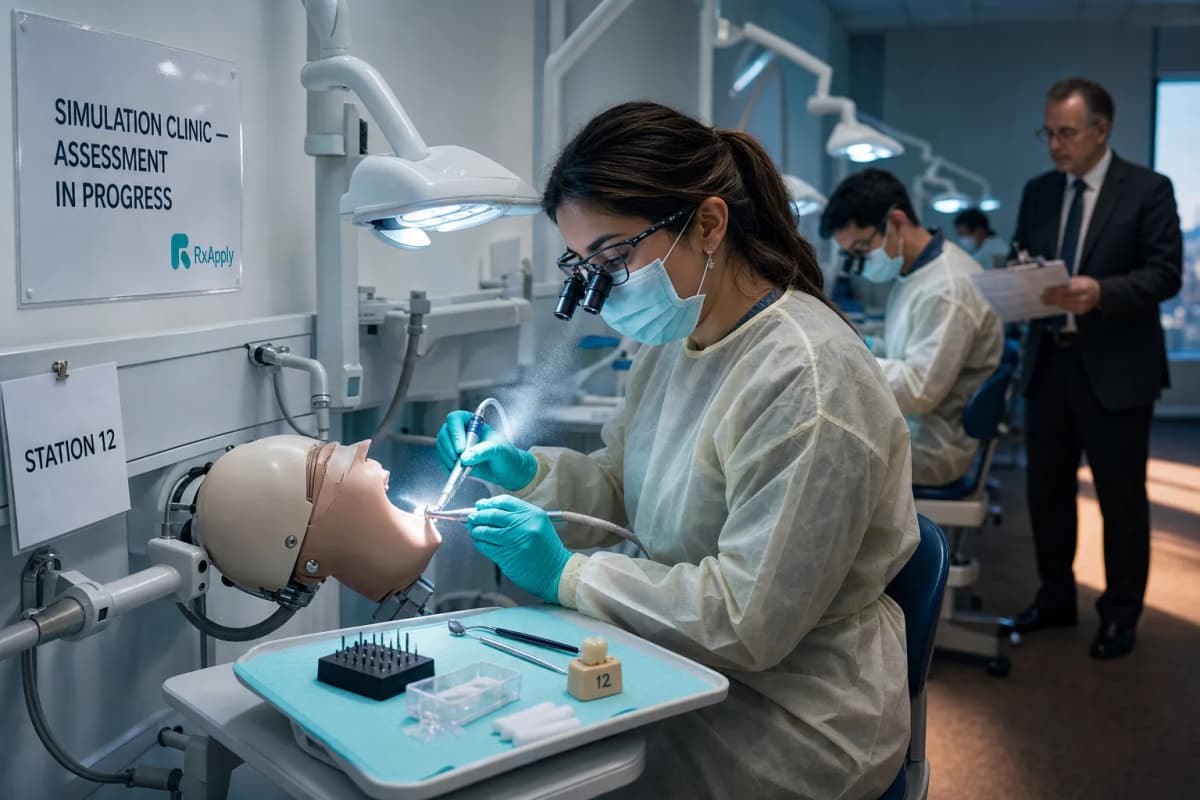
Day 1 — technical: simulated-head (phantom) work; preparations, restorations, and hand skills under tight time and precise protocol.
Day 2 — clinical and communication: OSCE stations covering clinical judgement, diagnosis, and patient-communication scenarios.
Registration costs AUD 4,775 in 2026, with sittings in three windows (Jan/Feb, May/Jun, Sep/Oct). Capacity is 24 candidates per session, raised to 28 from Period 2 of 2025 — roughly 300 extra places a year (ADC Annual Report 2024/25, retrieved 5 August 2026). The constraint is not how fast you register; it is that the chairs do not exist. Still treat registration day like the exam itself: account ready, international card live, and the window's opening time in Australian hours in your calendar. The 2027 application windows for all three practical periods are set out in the 2027 ADC examination calendar.
And the rule to know before any planning: failing any single component means retaking all of them. That kills the "I'll lean on my strong section" strategy; preparation has to be uniform.
Why do good dentists fail?
The recurring pattern in candidate reports has three roots:
First — the exam grades the standard of method, not just the result. The Australian examiner watches sequence, infection control, time management, and documentation as closely as the quality of the preparation itself. A dentist with ten years of good results from a personal technique loses marks precisely on that "method" if the exam protocol hasn't been drilled.
Second — distance from simulated work. A phantom head is not a patient: tactile feedback, sight lines, and posture all differ. A candidate with deep clinical experience but few phantom hours gets ambushed on Day 1.
Third — the language of the communication stations. Day 2 measures fluency in plain-English explanation: informed consent, treatment options, the anxious patient. Clinical knowledge without that fluency does not convert into marks.
None of these three is "weak dentistry"; all three are distance from the exam's format — and distance from a format closes with the right practice. A structured plan is the factor candidates most often credit in their own accounts of passing — but the ADC does not publish pass rates by preparation method, and does not endorse any provider, so treat that as reported experience rather than as a measured effect.
What do the passers do differently?
Four behaviours recur in successful accounts:
- Structured phantom practice against the clock — not "practise until it's good," but "good within the allowed time with the full protocol." Real preparation costs (course, materials, instruments) typically bring this stage to AUD 16,000–20,000; read that as an investment in passing once.
- At least two full dress rehearsals before the real sitting — real clothing, timing, and sequence.
- Spoken English rehearsal of the communication scenarios — ideally with an English-speaking partner or a colleague in Australia.
- Melbourne logistics settled early — accommodation near the venue, arrival days in advance; travel fatigue is the enemy of fine motor control.
A suggested 12-week plan
A framework consistent with passers' patterns: Weeks 1–2: review Australian protocols and standards + a timed baseline self-assessment on the phantom. Weeks 3–8: task-cycle training — two or three core tasks a week (crown prep, the major restoration classes, endo on the model) against time and a protocol checklist, plus two communication-scenario sessions a week in English. Weeks 9–10: full simulation number one + video/mentor review and targeted fixes. Week 11: full simulation number two under harsher conditions. Week 12: taper, routine consolidation, Melbourne logistics. If you are practising outside Australia, cover the phantom work with standard equipment (and ideally a short intensive course near the date) — and solve payments and travel money well in advance.
And if I fail?
Your written pass survives for 5 years if you sat it from March 2026 onward. If you sat it in 2025 or earlier it still expires after three years — the ADC did not extend periods already in place, so check your own date before relying on the newer rule. Either way, a practical fail does not zero the file. Reading your score report, isolating the weak component, and running one targeted practice cycle before the next window is the standard second-attempt pass pattern. What not to do: panic-book the nearest sitting just to "get it over with" — at this pass rate, every attempt deserves to be the most complete version of you.
Frequently asked questions
Which Day 1 tasks are heaviest? The reported pattern: crown preparations and complex restorations cause the most failures — not from ignorance, from time. Practise with a timer and make "finished within time" a personal pass criterion equal to quality.
Where do I get practice equipment? Preparation courses (in Australia and several international centres) have standard setups; outside Australia, a decent phantom head and handpiece are obtainable — several candidates sharing one rig is common and sensible.
What do I bring on exam day? Execute the official ADC list to the letter; off-list instruments cause entry friction. Keep a backup set of the delicate items (burs, mirrors) in your luggage — for calm, not for the exam hall.
How do I manage exam nerves? Those two full simulations are the best anxiolytic: your brain experiences the real day as "the third time." Treat sleep and arriving in Melbourne days early (letting your body clock settle) as protocol, not luxury.
Of two offered sittings, which do I take? The one with a safe margin after your true end of preparation — not the nearest. With seats vanishing in hours, "grab it before it's gone" is tempting; but an early seat with incomplete preparation is the most expensive seat in the world.
The strategy in five lines
The ADC practical is an exam of format; train the format, not just the dentistry. Go complete every time — "one failed task, retake everything" grants no mercy. Time is the hidden criterion of every task; never practise without a timer. Push your explaining-English to the unconscious level. And manage logistics — registration, travel, instruments, sleep — with the same seriousness as the exam; half of passing happens outside the hall.
One motivating arithmetic to close: this hard exam is the gate to the cheapest route (AUD 20–30k all-in) into a country with the fastest passport among the destinations and a market hungry for dentists. The toughness of the door is the price of the garden.
The full three-stage route, and this exam's place in it: the step-by-step ADC guide.
Even with this hard exam, Australia remains the most accessible 2026 destination — see why in our Australia guide.
About this article. RxApply is an independent education provider. It is not affiliated with, approved, endorsed by, or connected to ADC or AHPRA.