When we say the UK route costs "£25,000 to £45,000," two reactions are typical. Some say, "That much? The exams together aren't even eight thousand." Others, who have finished the journey, say, "I wish someone had itemised this at the start." This article is written for the second group — before they become the second group.
The exam figures are the GDC's official post-2026 numbers; the rest are the ranges candidates consistently report.
Layer one: official exam fees
The most transparent layer:
- ORE Part 1: £485 exam + £115 application processing = £600 (down 17 percent from pre-2026)
- ORE Part 2: £6,967 (up 65 percent — specialist clinical facilities, examiners, and VAT)
Official total: about £7,600 — assuming first-attempt passes in both parts. Every Part 2 retake is a budget of its own, and that single line explains the gap between the floor and ceiling of the total. The component scores show where the risk lives: DTP and Medical Emergencies pass high; what fails candidates is usually the manikin and clinical management — exactly the parts that demand money and time to prepare.
Layer two: preparation — where budgets diverge
For Part 1, many prepare with online resources and question banks; the cost is manageable. Part 2 is another story: manikin work needs an in-person course, a personal instrument kit, and repetition. Candidates' documented experience puts the true cost of Part 2 — course, instruments, and mocks included — at £11,500–13,000. A typical preparation run is three to five months, which means three to five months of UK accommodation or repeated trips, feeding straight into layer four.
One way to manage this layer: the ORE's manikin equipment overlaps heavily with the alternative LDS exam. Candidates who track both routes in parallel turn one preparation investment into two tickets.
Layer three: language and documents
The GDC accepts only in-person IELTS Academic (overall 7.0, minimum 6.5 per band) — no OET, no TOEFL, no home edition. This layer's budget is not one test fee; it includes courses and the possibility of a retake. For applicants in Iran, limited IELTS UKVI capacity may add a trip to a neighbouring country. Mind the two-year score validity as well: language done too early costs as much as language done too late.
Documents have their own chain: authentication in the country of origin, certified translation, and — a specifically British requirement — a solicitor's or notary's stamp on the translations. Two registration items are easy to miss: the hands-on ILS certificate (an in-person resuscitation course with its own fee and travel) and the documentation of 1,600 clinical hours — if your service certificate lacks itemised hours, fixing it at home is far easier than fixing it from London. The full chain is in the document checklist.
Layer four: travel, visas, and living
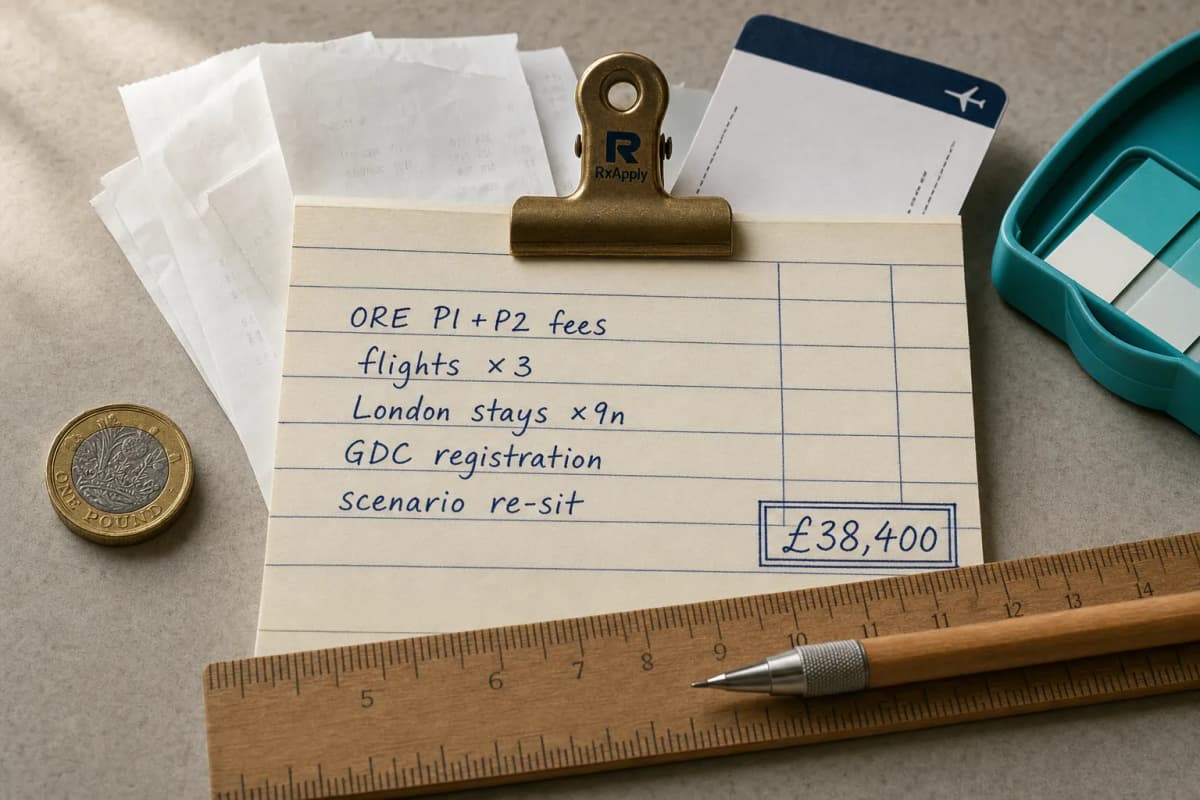
Both ORE parts run only in London. That means at least two trips (in practice usually more), a visitor visa for each sitting, and accommodation in one of Europe's most expensive cities. If your Part 2 preparation is in-person, months of London rent enter the calculation. This is the layer that turns a £25,000 budget into £45,000: the difference between "one pass with compressed preparation" and "one Part 2 retake plus six months living in Britain."
One way to shrink it: paid interim roles. Enrolling in an NEBDN dental nursing course (about £1,000–1,700) makes work as a trainee dental nurse legal from enrolment day — roughly £10–22 an hour — and for holders of dependant or student visas it covers part of the preparation period's living costs while tuning your clinical English to the British ear.
The other side of the ledger: return on investment
The UK is not the most expensive route (the US holds that title at USD 200,000–400,000), but it costs more than Australia or Germany. What rebalances the scale is two numbers: speed (about 18 months to GDC registration in the optimistic case — fastest of the five destinations) and income (a typical £75,000–150,000 a year, the highest of the five). Heavier investment, faster payback — especially if you close out PLVE and NHS work immediately after registration and income starts flowing within months.
The five-country comparison is in the cost guide.
Three decisions that shape your budget
First, Part 2 timing: passing on the first attempt is the biggest saving available; do not economise on its preparation — every pound withheld there risks another £6,967. Second, where you prepare: online preparation from home combined with a short in-person course is the standard cost-control pattern. Third, language sequencing: lock in IELTS before committing to an exam date; failing the language mid-route is the most expensive kind of stop.
And one rule for the whole budget: convert currency in stages and keep receipts for every transaction; the day you open a London bank account, you will thank yourself.
Frequently asked questions
Hold the budget in pounds or local currency? Convert near-term committed costs (a booked exam, an enrolled course) early; stage the rest.
Which line can actually be cut? None of the official ones. What is manageable: preparation location (online from home instead of extra London months), courses (targeted purchases, not everything), and living costs (cheaper cities for preparation, London only for the exam). The "retake" line is removable too — with proper preparation; it is the most expensive optional item.
How serious is interim income? Nursing-role pay (£10–22 an hour) will not cover London living fully, but it staunches the bleed — and builds a British CV and clinical English; for dependant-visa holders it is the default move.
Does LDS come out cheaper than ORE? On fees alone, yes — the three parts currently total roughly £4,000–4,550 against about £7,570 for ORE Part 1 plus Part 2, and the September 2026 restructure narrows that without closing it. But fees are the smaller half of either bill once preparation, travel and retakes are counted, and LDS's real advantage remains seats and calendar rather than price — full comparison.
When does the first income arrive? The standard pattern: GDC registration → private work or PLVE within months → a Performer Number in 6–9 months. The gap between your last big payment and your first salary, with a sound plan, is under a year — tell your family that number too; much of a budget's psychological weight is simply not knowing it.
The complete route — exam, language, visa, and work — in our UK guide.
About this article. RxApply is an independent education provider. It is not affiliated with, approved, endorsed by, or connected to GDC.