Choosing an English test is a decision usually made on half-information — and the mistake is expensive: a test your destination does not accept, or an edition (home, General) that does not count, means lost money and lost months. This guide compiles the acceptance rules of the four major English tests across the dental destinations, with current 2026 minimums and availability notes for candidates testing from Iran. (Germany is its own story: German and the FSP.)
The golden rule: destination first, then test
UK (GDC): the strictest. Only in-person IELTS Academic — overall 7.0, minimum 6.5 per band. OET, TOEFL, and IELTS Online are not accepted. That single-option rule deletes your plan B; prepare accordingly, and note the limited IELTS UKVI seats in Iran. (The alternative LDS route is stricter still: 7.0 in all four bands.)
Australia (AHPRA): the most flexible. Four tests accepted, with the score table updated on 23 April 2026: IELTS Academic 7.0 in listening, reading and speaking, and 6.5 in writing; OET at L350/R360/W350/S360; PTE Academic overall 63 with band minimums of L58/R59/W60/S76 (speaking the strictest); TOEFL iBT overall 91 with R22/L22/W23/S24. Note: the language requirement sits at AHPRA registration — the ADC exams themselves require none.
Canada: two layers. The NDEB exams need no language; English appears at residency (Express Entry: CLB 7 minimum — IELTS General 6.0 per band — with CLB 9 the smart target; IELTS General, CELPIP, and since 2023 PTE all accepted) and at the programs and provincial regulators — QP programs usually want IELTS Academic 6.5+, the BTDPC 7.0 per band, and the provincial regulators set their own bars. Quebec requires French (OQLF for licensure; TEF for immigration).
USA: the test belongs to the programs, not a single regulator. IDPs usually want TOEFL iBT, and the strict ones (NYU) demand 100+ with no IELTS accepted. Check your target programs' lists before anything else.
Mind the Academic/General split too — they are two different destinations: licensure bodies (GDC, AHPRA, provincial regulators) want Academic; Canada's Express Entry accepts General. A Canada-route candidate facing both layers is often wisest to sit one strong Academic that opens both doors — but confirm each body's current rule before registering.
Each test's personality — and access from Iran
IELTS Academic: the most widely accepted, and Britain's only key. Offered inside Iran, though UKVI seats are limited. If your destination is undecided, IELTS is the lowest-risk default.
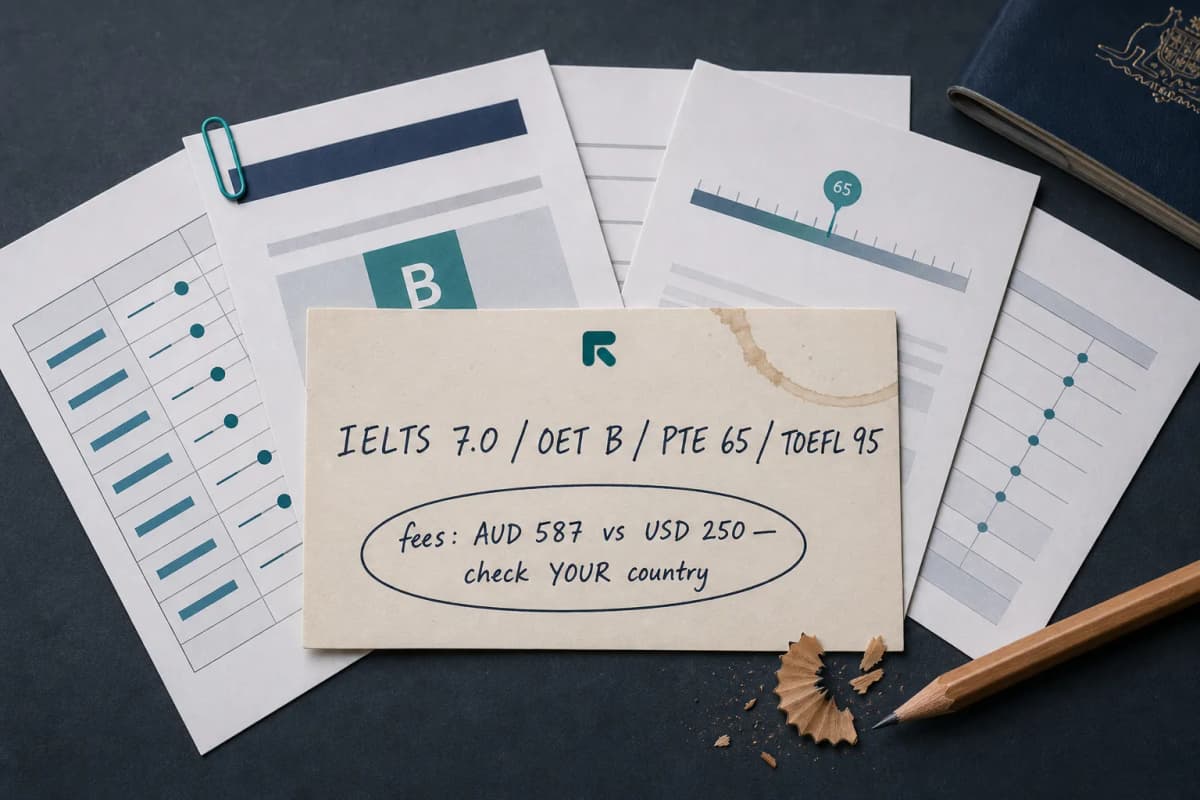
OET: the healthcare-specific test — patient role-plays, referral letters, clinical texts. For a dentist, familiar content often means a better score at the same language level. It has an authorised in-person centre in Tehran (paper and computer; AHPRA does not accept the home edition). 2026 fees: paper AUD 587, computer USD 455 — pricier than IELTS, but a rational investment on the Australian route. Results in 13–16 days.
PTE Academic: computer-based, AI-scored, the fastest results (~5 days), and 2026 fees around AUD 375–415 (USD 250–285). Not offered in Iran — Istanbul, Dubai, Doha, Yerevan, Tbilisi, or Baku. A serious option for Canadian immigration and AHPRA; useless for the GDC. Watch Australia's speaking floor of 76: if speaking is your weak band, PTE is the wrong pick — though conversely, candidates who freeze before human examiners often find the microphone easier.
TOEFL iBT: the key to American programs. Availability in Iran is limited, and many travel for it.
The three-step selection strategy
First, fix the destination — the table above shows there is no universal test; the closest thing is IELTS Academic. Second, if the destination is Australia, decide between IELTS and OET with one mock of each; the consistent report from colleagues is that OET's clinical content lowers anxiety and lifts performance. Third, build the calendar backwards: scores generally live two years — don't test so early that the score dies before final registration, nor so late that one failed attempt burns your main exam date. On multi-year routes (Canada), the right slot for language is the middle: after the AFK, before the residency profile.
And one short rule for the preparation itself: scores rise on test practice, not just on knowing English — all four exams are format-driven. Four to six weeks of targeted work with real practice material and two timed mocks is what most candidates find it takes to move about half a band. Treat that as a typical floor rather than a promise — nobody has published a study on it, ourselves included, and how far you move depends on where you are starting.
Frequently asked questions
Half a band short — retake the same test or switch? Read the score report first: three bands above threshold and one below points to targeted practice and a retake; a weakness wired to the format (speaking to a human examiner, say) points to switching formats (PTE for Australia/Canada).
Are single-skill retakes accepted? Some tests advertise them, but acceptance is body-by-body, and many regulators want one full sitting's report — get the rule in writing before counting on it.
Best OET practice resources? The official sample packs plus role-play drills of history-taking and referral letters with a colleague; because the scenarios are clinical, your best practice partner is another dentist, not a general English tutor.
Does my spouse's English matter? Not for your licence; for residency, yes — spousal language scores points in Canada's Express Entry and helps in some Australian routes. If family immigration is the goal, plan the language as a pair.
How close to the exam should I switch to pure practice tests? The final four to six weeks: format drills and timed mocks; before that, build the language itself (clinical vocabulary, active listening, daily writing). Mock-testing too early locks in your ceiling.
The decision table in one glance
UK → in-person IELTS Academic, no substitutes. Australia → OET if clinical content energises you and you want to test in Tehran; IELTS if you want multi-destination flexibility; PTE if microphone speaking suits you and the travel is acceptable. Canada → close the immigration layer with General/PTE and the program layer with Academic — or one strong Academic for both. USA → TOEFL, per your target programs. Germany → close this article and open the FSP guide.
And a calming principle to end on: language is the one component of every route you can practise from home, today, with no permission and no paperwork. Start it before everything else, and it will never be your bottleneck.
Language requirements in each destination's full context: Australia • UK • Canada • USA
About this article. RxApply is an independent education provider. It is not affiliated with, approved, endorsed by, or connected to GDC, AHPRA, NDEB, IELTS, OET, PTE or TOEFL.