The Canadian route runs on two parallel rails: the professional one (the NDEB exams) and the immigration one (permanent residency). The common mistake is running them in sequence — exams first, residency later. The right strategy is parallel; and the immigration rail for dentists has a specific name: occupation code NOC 31110 in the Express Entry system.
Why NOC 31110 matters to you
Express Entry is Canada's points-based PR system, and since category-based draws arrived, candidates with experience in healthcare occupations — dentists under code 31110 included — receive invitations in dedicated draws at lower scores than the general rounds. The numbers set the scale: 2025's healthcare draws closed in the CRS 462–510 range, and Q1 2026 has shown about 467 — scores within reach for a file with strong language and the right age.
The official eligibility checklist: a recognised dental degree with a WES Canada or ICAS evaluation (note: ECE is the US standard and is not accepted for Canada); at least six months' continuous occupation experience within the past three years (and one year / 1,560 hours for a full FSW profile); language at CLB 7 minimum; and — good news — no job offer required (though an LMIA-backed offer adds 50–200 points depending on level).
Your service years: an asset many undervalue
The recurring question from internationally trained colleagues: "Does my experience back home count?" Yes — your clinical work as a dentist, including a mandatory post-graduation service period (such as Iran's tarh), is countable foreign work experience under NOC 31110, provided it is documented properly: a certificate with the explicit job title "Dentist," clinical duties matching the NOC description (diagnosis, treatment, prescribing…), hours, and dates. That same certificate both qualifies you for the healthcare draws and activates your CRS experience points. (The wording requirements, country by country: the service-experience article.)
Language: the cheapest big points in your file
The functional minimum is CLB 7 (IELTS General 6.0 in each band), but the competitive reality is that each language step up moves tens of CRS points — nothing else in your file buys points at that exchange rate. CLB 9 (IELTS L8/R7/W7/S7) is the threshold that switches on the powerful skill-transferability multipliers (language × education × experience); if it is within reach, make it the target. Since 2023, PTE is accepted alongside IELTS and CELPIP; the test comparison is here. And for Quebec, French (TEF) replaces English — with federal bonus points for bilinguals.
Key fact: the NDEB exams have no language requirement, so the language can — and should — run in parallel with the AFK.
If the score falls short: the third rail — provincial programs
Provincial Nominee Programs are the rescue lane for files below the federal draw line: a provincial nomination adds 600 CRS points and effectively guarantees an invitation. For dentists, the most active doors have been Saskatchewan (SINP International Skilled Worker), Alberta (the AAIP Express Entry stream), Manitoba (MPNP), the Atlantic Immigration Program (New Brunswick, Nova Scotia, PEI, Newfoundland — built around a direct employer role), and BC PNP. The Atlantic provinces and low-population regions pair these doors with rural incentives — the same places where income runs higher and the residency door opens easier.
And one 2026 change that rewrites Ontario-centric plans: the OINP Human Capital Priorities stream closed on 26 June 2026; betting everything on Ontario is no longer a strategy.
Two money-and-calendar notes for 2026
IRCC government fees rose on 30 April 2026; if your file is near completion, align your submission calendar with the fee calendar. Alongside the fees, build your FSW proof of funds early: the money must sit in your account for months, traceable and documented — and for an applicant moving funds out of Iran, documenting the origin and route matters as much as the amount; an account topped up in the final week is a red flag to the reviewing officer.
A sample calculation: where the points come from
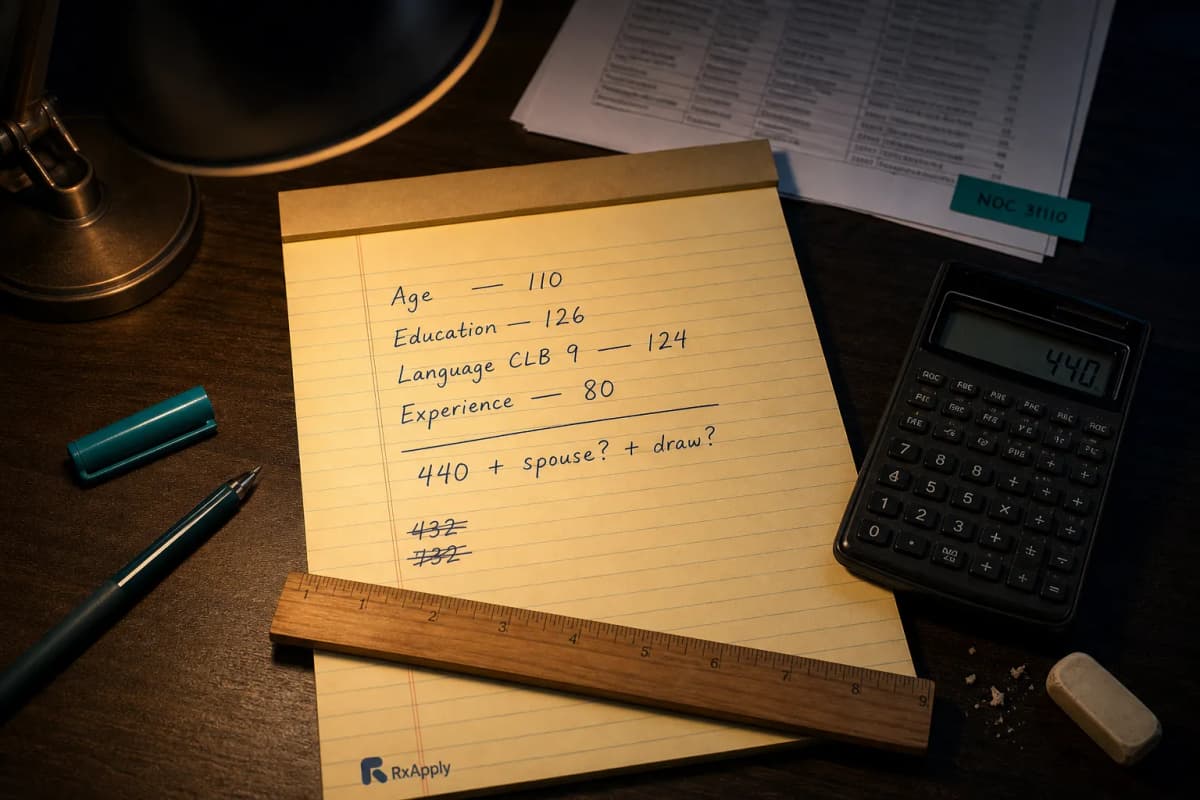
For a feel of the numbers, take a sample profile: a 29-year-old single dentist, professional doctorate with a WES evaluation, three years' experience (service period plus private practice), and CLB 9 language. That profile builds a base score that typically competes in the healthcare-draw range (~460–510). Now the same profile with CLB 7 instead of CLB 9: tens of points lower — usually below the invitation line. And the same profile at 35: lower again. Those two comparisons compress the whole strategy: language and time are your two levers; the degree and experience you already have.
(Compute your own profile with the official CRS calculator; the figures above are directional.)
The suggested sequence for a 2026 file
Year one: language to your ceiling (target CLB 9) + AFK registration + WES/ICAS evaluation + authenticated, translated work certificates. Year two: the ACJ + an Express Entry profile the moment you qualify + watching the healthcare draws and provincial doors (with a provincial application if needed). After PR: the NDECC and provincial registration run far smoother from inside Canada — and only then do the BTDPC and QP options open.
Frequently asked questions
No work experience yet (new graduate)? Build experience first — even the home-country service period; without six months in the occupation, the healthcare-draw door stays shut, and the general profile rewards experience too.
How much does age matter? A lot — age points slope downward from about 30; every postponed year of language and profile burns real points.
What does a spouse add? Spousal language and education score points; sometimes swapping who leads the application raises the household total — compute both scenarios.
How long does WES take, and what does it want? Transcripts and the degree, officially translated, sent through the prescribed channel; typically weeks to months — start it first among your file's components, since it stays valid for years.
Can I get PR before passing the NDEB exams? Yes — Express Entry has nothing to do with a Canadian dental licence; degree, experience, and language suffice. Many take PR first and continue the exams from inside Canada.
Do I need a consultant or lawyer? For a standard file, Express Entry is the most self-serviceable immigration system among the five destinations; for complicated histories (visa refusals, complex records) a licensed RCIC or lawyer earns their fee — and either way, the document-first principle stays with you.
Both rails — exams and residency — in one picture: our Canada guide.
About this article. RxApply is an independent education provider. It is not affiliated with, approved, endorsed by, or connected to IRCC. This is general information, not immigration advice. Consult a licensed immigration adviser for your own case.