

Unlike most countries, the United States has no "pass the exams, get the licence" route for foreign-trained dentists. For the majority, the main gateway is going back to university: IDP or Advanced Standing programs — two-to-three-year courses that end in an American DDS or DMD. This article explains how they work, what they truly cost, and what your realistic odds look like.
What exactly is an IDP?
An International Dentist Program is a compressed pathway that drops a foreign-trained dentist into the middle of a DDS program — usually third year. You become a student again, pay full tuition, work the university clinic, and graduate with a degree equivalent to your American classmates'. The big payoff: that degree opens all 50 states and carries none of the restrictions of the alternative routes.
Applications run through the centralised CAAPID system (under ADEA). The fixed elements of a file: a credential evaluation (usually ECE Course-by-Course — note that ECE is the US standard; Canada wants WES or ICAS), a passed INBDE, an English score (many leading programs want TOEFL iBT above 100; NYU explicitly does not accept IELTS), recommendation letters, and a personal statement.
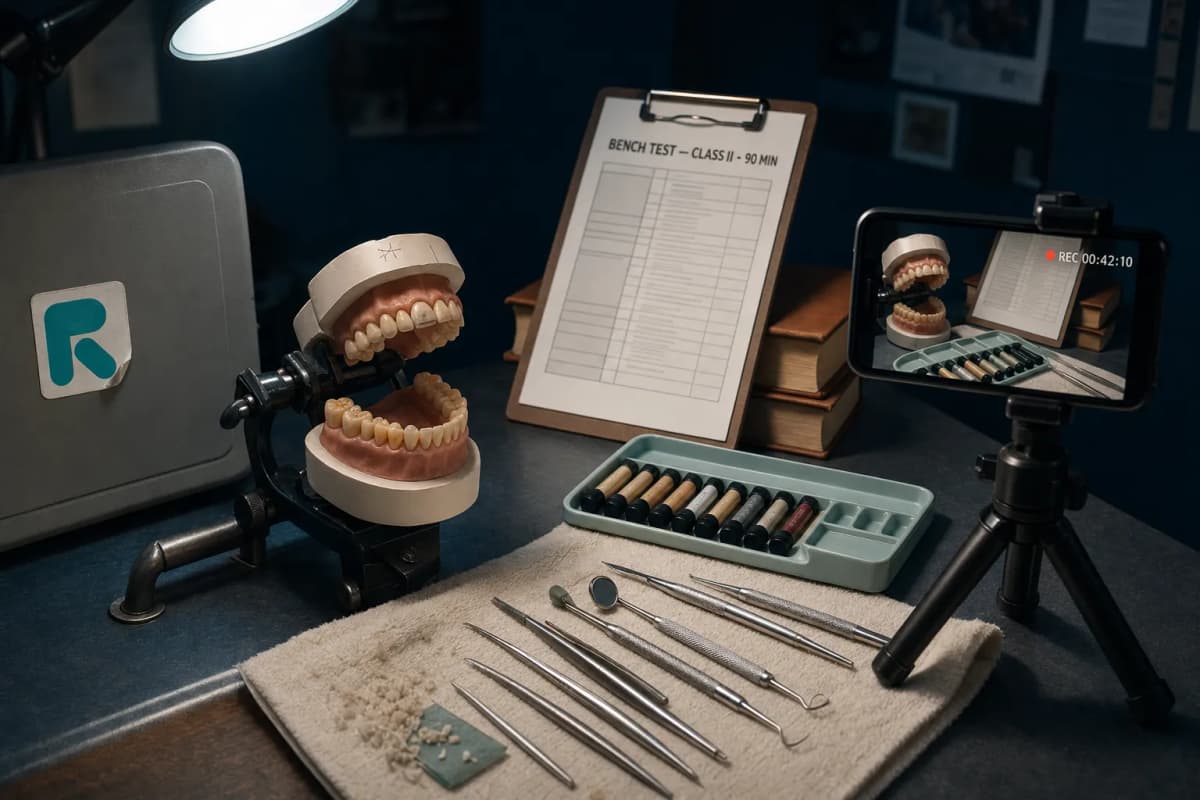
And one station that gets too little attention: the bench test — a hands-on typodont exam many programs give their finalists: crown preparation, a Class II restoration, sometimes a wax-up, under time pressure and to an American standard. An invitation to the bench means your paper file has already passed; from here, your hands do the talking. Serious candidates complete a phantom-head practice course before invitation season.
The numbers to see before you decide
Let's be candid: the IDP is the most expensive dental licensure route among all major destinations.
- Annual capacity: roughly 350–450 seats across the 25–28 CAAPID-listed programs — for applicants from the entire world.
- Typical total cost: USD 250,000–380,000 (tuition of 130–220k plus 25–50k per year of living costs across a two-year program).
- The whole US route, from credential evaluation to licence: usually USD 200,000–400,000.
Set those figures against the entire Australian route (about AUD 20–30k) or Germany (EUR 20–50k) and the scale of the decision becomes clear — the full comparison is in our cost guide.
In fairness, the financial case for the IDP deserves stating too: US dentist incomes are among the highest of the five destinations, and the market is by far the deepest — particularly in the states with large Iranian communities (California above all, the New York metro, the DC–Maryland–Virginia corridor, Texas, plus Seattle, Atlanta, and Boston), where an established professional network genuinely softens the landing.
The alternative: residency-based licensure
The lesser-known option is licensure through residency: in certain states, completing a CODA-accredited residency (such as a GPR or AEGD) can substitute for the American degree. As of 2026 the confirmed states are Connecticut, Illinois, Michigan, Mississippi, Minnesota, New York, Ohio, Oregon, Texas, Virginia, and Washington. Several states that appear on older lists — Wisconsin, Massachusetts, Indiana, Iowa among them — are not confirmed for 2026, and Florida formally requires a CODA-approved IDP; always verify with the state board itself.
The advantage: far lower cost (residencies usually pay a stipend). The limits: your licence is confined to those states, competition for international applicants is intense, and there is a visa wrinkle — F-1 OPT for dentistry is capped at 12 months (it does not count as STEM), which squeezes the post-study work timeline. Minnesota also operates its own direct-licensure route with particular conditions.
After graduation or residency, state licensure still requires a clinical board exam — ADEX — administered by the American Board of Dental Examiners (ABDE), the body the CDCA-WREB-CITA merger produced — is the most widely accepted, with its periodontal component becoming mandatory from 1 August 2026. CRDT (which absorbed SRTA) and DLOSCE are accepted state by state. The old names still appear in forum posts and older guides; check which examination your target state names today, because the agencies have consolidated faster than the advice about them has.
The 2026 reality for Iranian applicants
Since January 1, 2026, Presidential Proclamation 10998 has fully suspended student and work visas (F-1, J-1, H-1B) for Iranian nationals. Winning an IDP seat is one thing; sitting in its classroom is another. Green-card holders are exempt. Dual nationals may be exempt only if they apply on the passport of their non-Iranian nationality — the proclamation otherwise treats anyone who has ever held Iranian nationality as Iranian, so a second passport is not by itself a way through. Confirm your own case at travel.state.gov (retrieved 5 August 2026). For everyone else, the US route has become a "map kept ready for the day the door reopens": evaluate your credentials, pass the INBDE, and keep an active destination running in parallel. The full analysis: Proclamation 10998 and your options.
What makes a CAAPID file strong?
Programs weigh three questions: Can you handle the coursework (GPA, INBDE)? Are your hands reliable (bench test, documented clinical history — including properly certified service years)? And can you pay (proof of funds)?
Successful applicants share recognisable habits: an INBDE pass before applying; a personal statement built on real clinical experience rather than generic passion; recommenders who have actually watched you work; and simultaneous applications to 8–12 programs instead of two or three famous names. The cost of a few extra applications is nothing next to the cost of losing a year.
The CAAPID calendar, compressed
The cycle is annual and programs review in order of receipt; arriving late means the seats are gone. The compressed preparation timeline: 12–8 months before the cycle: ECE evaluation + INBDE preparation + English. 8–4 months before: INBDE passed, letters, statement, phantom practice for the bench. Cycle opens: submit within the first weeks to 8–12 programs. Invitation season: bench tests and interviews — be ready to travel. Draw this calendar onto your own year and date it backwards from the deadline; a file submitted "whenever it's ready" is effectively submitted a year late.
Frequently asked questions
Can I apply without the INBDE? Some programs allow it, but in the 2026 market a file without the INBDE is effectively second-tier.
Is age or graduation year a barrier? There is no formal limit, but a long gap from clinical work needs explaining — and compensating, with courses and recent experience.
Which credential evaluation? Most programs want ECE Course-by-Course; check your target list before paying.
How much proof of funds? Usually first-year coverage (tuition plus living); each program states its figure — and if funds originate in Iran, plan the transfer and its documentation early.
IDP or residency? With a green card and limited capital, weigh the eleven residency states first; if you want 50-state freedom and the classic route — and the capital exists — the IDP.
Before any payment, review the full US picture — exams, costs, and visa status — in our USA guide.
About this article. RxApply is an independent education provider. It is not affiliated with, approved, endorsed by, or connected to ADEA, CAAPID, ABDE or any state dental board.


