

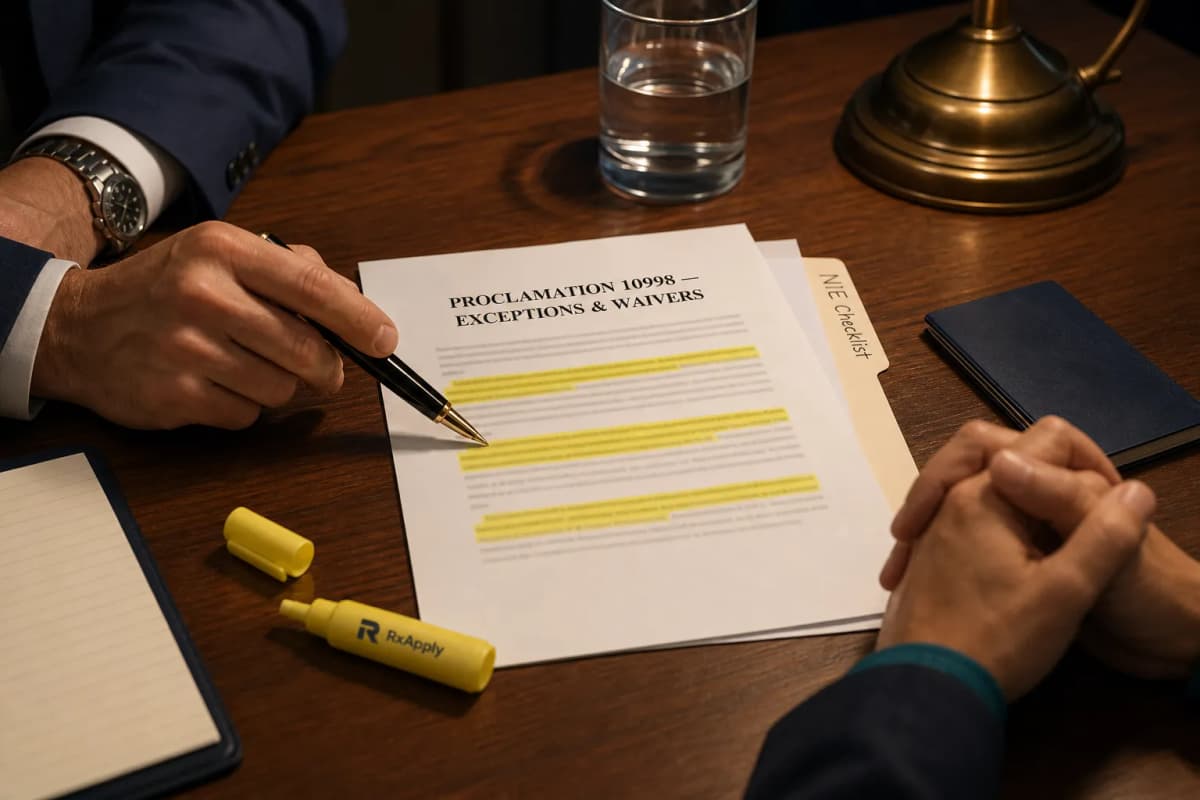
For dentists who had spent years building a US plan, January 1, 2026 was a bitter date: Presidential Proclamation 10998 fully suspended the issuance of F-1 (student), J-1 (exchange), and H-1B (work) visas for Iranian nationals. The backbone of the classic route — IDP admission on a student visa, residency on a J-1, employment on an H-1B — is, for Iranian passport holders without US status, cut.
This article sets the emotion aside and answers three practical questions: Who is exempt? What is still possible? And what does a rational 2026 plan look like?
Who is exempt?
The most important exemption is clear: green-card holders (US permanent residents) are not covered by the proclamation; US citizens and dual nationals travelling on a second passport are likewise outside its scope. If you or your spouse holds a green card, the IDP and residency routes remain open — and the competition has, if anything, thinned slightly.
Alongside the proclamation, USCIS policy memo PM-602-0194 has placed immigration petitions from Iranian applicants under an effectively indefinite processing hold — a sign that the restriction lives not only at the embassies but inside the administrative machinery. And in the background, the 2025–2026 sanctions campaign (more than a thousand new OFAC designations) has made banking and payments more delicate for Iranian files.
What is still possible?
Here is the point that gets lost in the gloom: Proclamation 10998 suspended visa issuance — not the validity of your credentials and exams. Four things remain fully available:
The INBDE. It runs in Dubai, Istanbul, Yerevan, and several other centres, and a pass never expires. A file strengthened with the INBDE today stands at the front of the queue on the day the doors reopen. Full guide: the INBDE article.
Credential evaluation (ECE) and document work. The authentication chain in Iran and submission to evaluators has nothing to do with visas and takes time anyway; doing it during the waiting period cuts your opportunity cost. See the document checklist.
The employer-independent green card — EB-2 NIW. The National Interest Waiver is designed for applicants with a strong academic-professional record (research, publications, distinguished work). Realistically: the USCIS memo has effectively frozen Iranian petitions and the NIW is no quick fix; but for strong files, it is an option some families keep on the table for the multi-year horizon. Its more demanding cousin, EB-1A (extraordinary ability), only makes sense for genuinely exceptional CVs; and corporate routes such as the L-1 require a business structure that rarely fits clinical work.
Building the file from a third country. A growing share of colleagues pursue the US from the vantage point of another residence (Canada, Australia, Europe): a second passport or solid residency opens future visa categories — and an international career strengthens an NIW file.
The rational 2026 plan: two parallel tracks
The pattern we see among Iranian dentists handling this period well is neither full stop nor passive waiting; it is two parallel tracks:
Track one — the active destination. The country where you sit exams and earn a licence now. Australia (accepts Iranian certified translations, lowest costs, exams in Dubai and Istanbul), Canada (NDEB exams start from Iran with no residency requirement), and the UK (the ORE with refreshed capacity from 2026) are the three main candidates. Full comparison: choosing your country.
Track two — a US file kept warm. INBDE, credential evaluation, and an academic CV maintained in the background. Immigration proclamations have come and gone throughout American history; nobody knows this one's expiry date, but a ready file is the only thing within your control.
The two tracks are complements, not rivals: preparing for Canadian or Australian exams keeps your clinical knowledge sharp for the INBDE; income in the active destination funds the US plan later; and — above all — your family starts living, instead of spending years in America's waiting room.
If you are caught mid-route
Three common situations, briefly: You hold an IDP admission but no visa — write to the program about deferral; most are familiar with the Iranian situation in 2026. You are inside the US on a valid visa — your position differs; consult an immigration attorney before any outbound travel, because leaving may mean not returning. You have a petition pending at USCIS — a processing hold is not a denial; keep the file alive and documented with counsel.
Following the news — without burning out
This story is noisy and anxiety-inducing; three rules for healthy monitoring: Limit yourself to primary sources — the text of proclamations, USCIS memos, embassy notices; not undated Telegram screenshots. Anchor to your calendar, not to speculation — the only news that changes your plan is an official change in visa status; the rest is noise. Review quarterly, not daily — a two-track plan is designed precisely so you do not need daily monitoring; that is its greatest psychological gift.
And write down your decision rule for reopening day now: "If visas reopen while I am mid-way through my active destination, under what conditions do I switch?" The answer composed in today's calm is wiser than the one improvised in that day's excitement — and for most families, the right answer is "finish the active destination's licence, then decide from a position of strength," not abandoning the road halfway.
Frequently asked questions
Does the proclamation have an end date? It was issued without one; its repeal or modification is a political decision in Washington. Plan without assuming a date.
What about B1/B2 visitor visas? They are suspended too. The proclamation does not merely target student and work visas: Iran is on the full suspension list, which covers all nonimmigrant and immigrant visa categories, B-1/B-2 included. Only the narrow listed exceptions apply — lawful permanent residents, dual nationals applying on their non-Iranian passport, immigrant visas for persecuted religious and ethnic minorities, Special Immigrant Visas, and participants in major sporting events. (The narrower list limited to B-1/B-2 and F/M/J applies to the partially-restricted countries, not to Iran.) Studying or working on a visitor visa would in any case be neither legal nor wise. Source: travel.state.gov, updated 2 February 2026 — retrieved 5 August 2026.
My spouse holds a green card — what about me? Family petitions involving resident relatives follow their own legal track, beyond this article's scope — consult a US immigration attorney; the general principle is that the proclamation's exemption attaches to the applicant's own status.
How much should this weigh in choosing a country? Heavily. In the five-destination comparison, the US has — for Iranians without status — lost its accessibility column, and a realistic ranking has to be drawn with that assumption until further notice.
Follow the complete, current US picture — exams through visa status — in our USA guide.
About this article. RxApply is an independent education provider. It is not affiliated with, approved, endorsed by, or connected to the US Department of State or USCIS. This is general information, not legal or immigration advice; consult a licensed attorney for your specific situation.


