

Both parts of the Overseas Registration Examination are sat in person, in London. That means at least two entries into the UK, each requiring a visa if you hold an Iranian passport, and each bounded by a limit most candidates only discover after they have booked something.
The limit itself is simple. What surprises people is the second half: the visitor rules contain a named extension route for doctors sitting the PLAB test, and no equivalent for dentists sitting the ORE. That asymmetry is written into the Immigration Rules, and it changes how you should sequence a multi-year exam campaign.
RxApply is an independent education provider. It is not affiliated with, approved, endorsed by, or connected to the General Dental Council or the Home Office. This is general educational information about published licensure processes — not immigration, legal, or professional advice, and not a substitute for a licensed adviser in the destination country. Official requirements are published at gdc-uk.org and gov.uk.
How long can you stay in the UK on a visitor visa for the ORE?
A Standard Visitor may be granted up to 6 months per entry (Immigration Rules, Appendix V, V 17.2). That is the ceiling for an ORE candidate, and there is no route to extend it from inside the UK. Appendix V lists exactly five grounds for a visitor to extend: a top-up where less than 6 months was granted, private medical treatment, academic activity, a PLAB resit, and an unpaid clinical attachment after passing PLAB (V 17.3). The ORE and the General Dental Council appear in none of them. A dentist who fails Part 2 must leave the UK and re-enter for the next sitting. The visa itself can be valid for 2, 5 or 10 years — £506, £903 and £1,128 respectively from 8 April 2026, against £135 for a 6-month visa — but the 6-month cap applies to each individual visit regardless. Sources: Immigration Rules Appendix V and the Home Office fees table, checked 21 August 2026.
The six months does not start when you think it does
Six months from arrival is the rule most people carry in their heads. It is only half right, and the missing half is expensive.
Under Article 4 of the Immigration (Leave to Enter and Remain) Order 2000, a visit visa gives you, on each arrival, either six months from the date of arrival if six months or more remain of the visa's validity, or only the visa's remaining validity if less than six months are left. So a 6-month visa valid from 1 January and first used on 1 March does not buy you until September. It ends at the turn of June, because that is when the visa's validity ends.
This mechanic is the practical argument for a longer visa. A 10-year visa has more than six months of validity remaining for all but its final six months, so almost every entry starts a clean six-month clock. A 6-month visa spends its validity whether you are in the country or not.
The extension doctors get, and dentists do not
Here the rules are worth quoting rather than paraphrasing.
For doctors, V 17.3(d) grants up to a further 6 months "in order to resit the Professional and Linguistic Assessment Board Test"; V 15.3 sets the evidence for it — written confirmation from the General Medical Council. Pass PLAB, and V 17.3(e) allows a further extension for an unpaid clinical attachment — up to 18 months in the UK in total.
Now V 15.4, which governs the in-country extension for a clinical attachment or dental observer post:
"Where the applicant is applying for permission to stay as a Visitor and they are an overseas graduate of a medical, dental or nursing school intending to undertake an unpaid clinical attachment or dental observer post, they must have been successful in the Professional and Linguistic Assessment Board test."
The rule names dental graduates and dental observer posts, then conditions the extension on passing an exam dentists do not sit. The dental extension is textually unreachable by a dentist.
The pattern repeats in the permitted activities. PA 10.1(b) lets overseas graduates of medical, dental or nursing schools "take the following test/examination in the UK" — and names only two: PLAB, and the OSCE — which here means the Nursing and Midwifery Council's nursing examination, not any dental OSCE. (V 11.3 requires written confirmation from the NMC.) Note also that the OSCE, unlike PLAB, is an entry ground only: it is not among the extension grounds either. ORE candidates enter under the Home Office's general position that "individuals can enter as visitors to sit a test or an exam in the UK" (Visit caseworker guidance, published for Home Office staff 25 February 2026). That 70-page guidance mentions PLAB five times. It does not contain the words "General Dental Council", "GDC" or "Overseas Registration Examination" once.
This looks like drafting history rather than policy: the exam-visitor provisions were built around the GMC and the NMC and never revisited for the GDC. We could find no record of anyone raising it — not in GDC papers, British Dental Association policy, parliamentary written questions, Hansard, statements of changes, or Migration Advisory Committee reports. It is not a campaign. It is a planning constraint, and you should plan around it.
What this costs you when Part 2 goes wrong
Six months sounds generous until you lay the exam calendar over it.
Part 1 booking opens eight weeks before each sitting, and the GDC states that places "are taken up fast, normally on the same day that the booking window opens" — in practice within 30 minutes this year. The GDC says it will endeavour to release Part 1 results within 30 working days of the exam, and aims to send Part 2 results within 20 — targets, not guarantees. Part 2 seats are scarcer: 144 places for the September 2026 sitting and 200 per sitting through to April 2027, against 600 per Part 1 sitting.
So the sequence a failed Part 2 forces is: sit, wait up to 20 working days for the result, wait for the next booking window, compete for a seat, and — because you cannot extend — do all of that from outside the UK. The GDC's own five-year rule adds the pressure: under the International Registration Rules 2023, Part 2 must be passed within five years of your first attempt at Part 1, with a maximum of four attempts at each part. (Rule 5(3) discounts the period from 2 April 2020 to 8 March 2023 from that five years — relevant if your first Part 1 attempt predates March 2023, and a detail the GDC's public pages omit.) The full exam mechanics are in our ORE guide.
The long-term visitor visa is probably the right instrument
If the ORE is a multi-year campaign, applying separately for each sitting means a fresh application, a fresh refusal risk and a fresh biometrics trip every time. A long-term Standard Visitor visa collapses that into one.
| Visa | Fee from 8 April 2026 | Maximum stay per visit |
|---|---|---|
| Standard Visitor, up to 6 months | £135 | 6 months |
| Long-term, 2 years | £506 | 6 months |
| Long-term, 5 years | £903 | 6 months |
| Long-term, 10 years | £1,128 | 6 months |
Visitors do not pay the Immigration Health Surcharge, so the fee is the whole visa cost. Set against a Part 2 fee of £6,967, the £993 difference between a 6-month and a 10-year visa is small — and it buys you the clean six-month clock described above. Two caveats: a long-term visa is a permission to seek entry, not a guarantee of it, and V 4.2(b) still requires that you will not "live in the UK for extended periods through frequent or successive visits". Where the whole budget sits is in our cost breakdown.
What to book first
The GDC is unambiguous about who carries the visa risk. Its published withdrawal and refund policy states that being unable to obtain a UK visa is not an exceptional circumstance, and puts the responsibility on the candidate to establish, before booking, that they will be permitted to be in the UK for the exam.
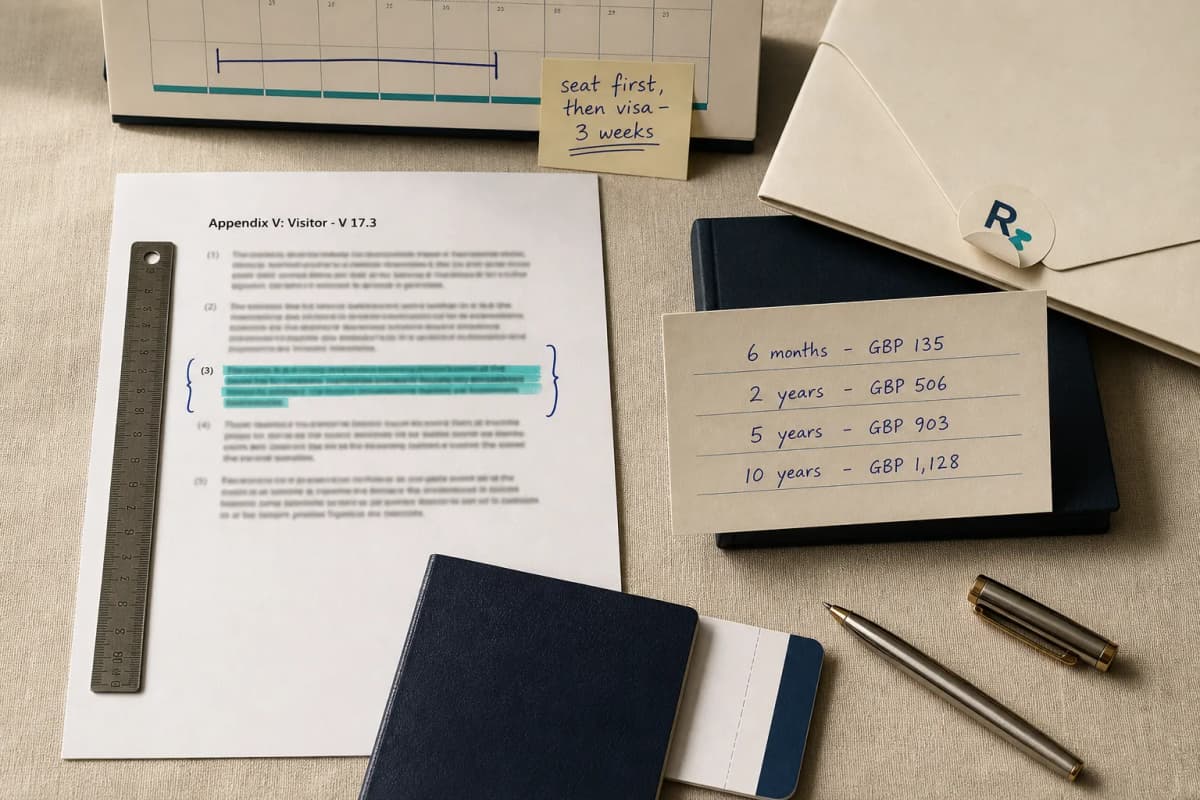
A refused visa does not get your exam fee back. Candidates in the Iranian dental community generally book the seat first and apply for the visa second. Their reasoning is that a dated seat confirmation documents a specific purpose of visit, and that a visa without a seat is money spent on nothing. That is community practice rather than a rule, it carries exactly the fee risk the GDC describes, and what evidence suits your own application is a question for a regulated adviser.
The arithmetic is workable: booking opens eight weeks before the sitting, and UK Visas and Immigration currently quotes 3 weeks for a Standard Visitor decision. Iranian applicants should add travel to that. An application requires biometrics at a visa application centre, and the status of the Tehran centre is not something to assume: the UK's visa partner has published notices describing it as temporarily closed while its own booking pages continue to list it as operating, and we could not resolve the contradiction from public sources. Check the position on the day before you commit to a booking, and budget for a centre in a neighbouring country if Tehran is not enrolling.
Three things you will hear that are not true
"You can only spend 180 days in the UK in any 12 months." There is no such rule in UK immigration law. It is a Schengen rule that has migrated into UK conversations. The word "180" does not appear anywhere in the Home Office's 70-page visit caseworker guidance. The real test is qualitative: caseworkers assess your travel history, the time elapsed between visits, whether you spend more time in the UK than at home, and whether you have registered with a GP or put children in UK schools.
"Iranians only have about a 10% approval rate for UK visit visas." Home Office data does not support this. Table Vis_D02 of the immigration system statistics shows 9,106 visit visas issued to Iranian nationals against 7,228 refused in calendar year 2025 — a grant rate of about 56%. No nationality with a meaningful caseload sits anywhere near 10%; the lowest in that year was Somalia at roughly 34%. Source: Immigration system statistics, year ending March 2026, published 21 May 2026, retrieved 21 August 2026; 2025 figures are marked provisional by the Home Office and the next release is due 27 August 2026.
"This route is guaranteed if you do X." Nothing about a visa outcome, an exam seat, or an exam result is guaranteed by anyone, including us.
Frequently asked questions
Can I sit Part 1 outside the UK? No. The GDC holds Part 1 in person at London venues and Part 2 at the UCL Eastman Dental Institute. Both parts require UK entry.
Can I switch from a visitor visa to a work or student visa without leaving? No. A visitor cannot switch in country; you apply for the new category from outside the UK.
Is 6 months guaranteed on arrival? No. Six months is a maximum, not an entitlement. A Border Force officer may examine you on arrival and, where your purpose differs from the one in your visa, cancel your permission (Immigration Rules, Part Suitability, SUI 25.2).
Is there a longer visitor route for dentists? One exists, and almost no ORE candidate qualifies. The 12-month visiting academic visa (£234) requires you to be highly qualified — the guidance says generally a PhD or higher — and currently working in that field at an overseas academic institution. The Home Office guidance notes that this is the one place the visitor route makes provision for family — a partner and children may accompany an academic visitor for up to 12 months.
This is general educational information about published licensure processes — not immigration, legal, or professional advice, and not a substitute for a licensed adviser in the destination country. All rules and figures above were checked on 21 August 2026. UK immigration advice is regulated: for your own circumstances, use an adviser registered with the Immigration Advice Authority.
Primary sources: Immigration Rules Appendix V: Visitor · Appendix Visitor: Permitted Activities · Visit caseworker guidance · Home Office fees, 8 April 2026 · GDC: the ORE


