dental immigration documentsdocument authentication dentistryGood Standing certificate medical council

The Dental Document Checklist Before Leaving Iran: 17 Records That Get Harder to Obtain Later

The complete document list for a dental migration file — degree and transcripts to service certificate and Good Standing — with Iran's authentication chain, the evaluation/translation table for five countries, the Mikhak portal, and the mistakes that cost months.

The Dental Document Checklist Before Leaving Iran: 17 Records That Get Harder to Obtain Later

One simple rule condenses the experience of hundreds of files: every document issued in Iran should be obtained while you are still in Iran. Getting the same record from abroad — by power of attorney, the Mikhak portal, and a relative's legwork — is possible, but each round costs weeks and sometimes months. This checklist orders the records by priority, with the authentication chain and the five destinations' differences.

The file's core: academic and professional records

  1. The dental degree — the file's mother document
  2. Full transcripts — the basis of every evaluation
  3. Clinical hours broken down by department — the record few people know they will need; some evaluations and university programs require the university to certify hours per discipline (operative, perio, endo…). It is slow to issue; start early.
  4. The service-completion (or exemption) certificate — with the explicit job title "Dentist," dates, and clinical duties; for Germany, necessarily conveying "als Zahnarzt." (Why the wording decides outcomes)
  5. Medical council card and registration certificate (IRIMC)
  6. A Good Standing certificate from the medical council — your professional clean-record document; virtually every regulator wants it. Its validity is short (usually three to six months in the recipient's eyes) — time its issuance to your submission, not your errands.
  7. Clinical employment certificates — from every practice/clinic/centre, on letterhead with dates, weekly hours, and duties; for Canada's Express Entry this is the experience-points pillar.
  1. Birth certificate and national ID (with certified translations)
  2. A valid passport — with validity covering your planning horizon
  3. Marriage certificate (if applicable)
  4. Police clearance — from Iran, and later from any country where you studied or worked; short validity, so obtain near the time of need
  5. Military-service documents (for men) — needed for passport issuance/renewal and some files
  6. Destination-standard photographs — sounds trivial; the standards differ

The records that set files apart

  1. Professional recommendation letters (at least two independent referees) — professors or senior colleagues, on letterhead with contact details; effectively mandatory for university programs (IDP, QP, BTDPC)
  2. A destination-standard CV — for Germany, the tabular Lebenslauf style
  3. Language score reports — minding their expiry dates (which test for which destination)
  4. An organised digital file — high-quality colour scans of everything above, cleanly named in English, in cloud storage plus one offline copy with family

The authentication chain: never shuffle the order

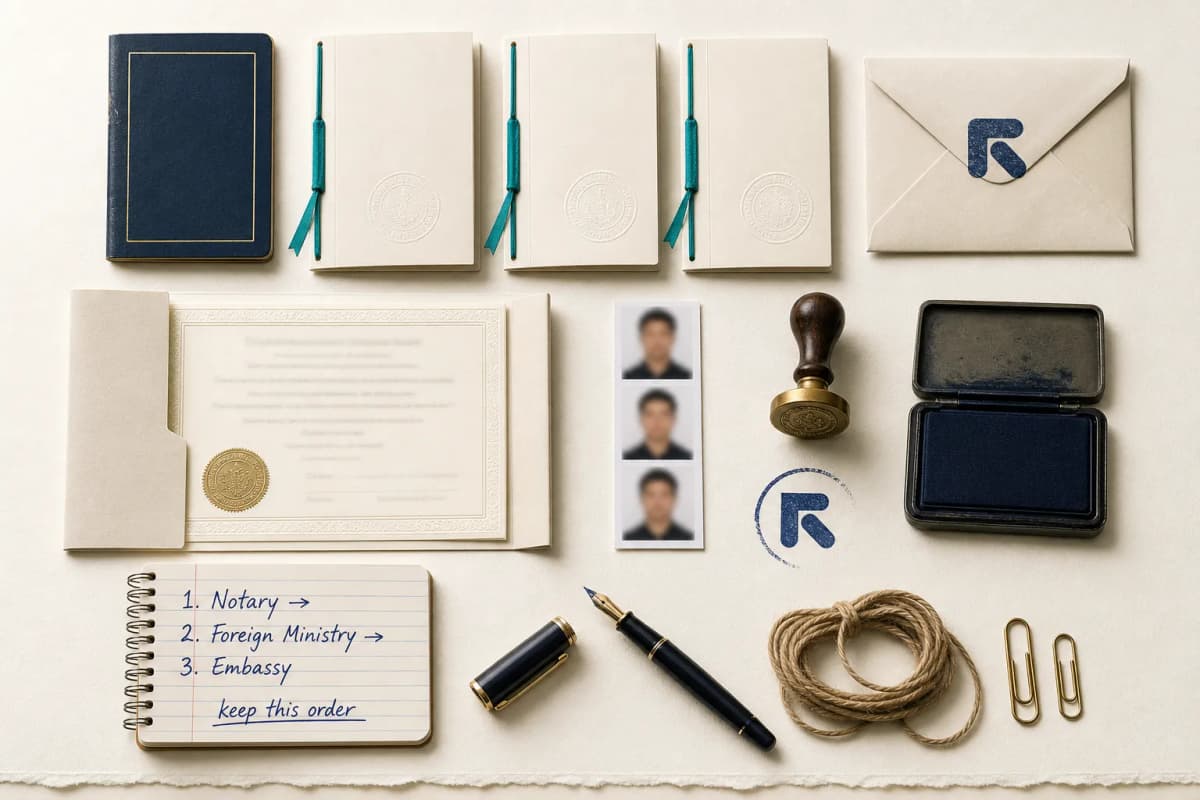
For academic records the correct order inside Iran is: university (graduates' office) → the Health Ministry's education services centre (the "translatable" stamp) → certified translation office → Ministry of Justice → Ministry of Foreign Affairs → destination embassy. Azad University graduates add the central organisation's validation before the Health Ministry. Personal records run the parallel track: notary → Justice → Foreign Affairs. Error-free, the whole process typically takes three to six weeks at a cost in the few-million-toman range (May 2026 rates).

Because Iran is not an Apostille member, there is no shortcut through this chain. And if you have already left with a record missing: the Mikhak consular portal exists exactly for granting power of attorney to family — the standard remote-document fix, at the price of weeks per round. Close the checklist before the flight.
The Dental Document Checklist Before Leaving Iran: 17 Records That Get Harder to Obtain Later

What each destination wants: the one-glance table

  • Australia: Iranian certified translations accepted; no notarisation since January 2025 — the lightest paperwork. (For some non-academic documents inside Australia, NAATI translation is the standard.)
  • Canada: credential evaluation by WES Canada or ICAS (not ECE); other records with certified translation plus authentication.
  • USA: ECE Course-by-Course for CAAPID; authenticated Iranian certified translations are the evaluation's basis.
  • UK: certified translation plus a solicitor's/notary's stamp for the GDC; keep the ILS certificate and the 1,600-hour clinical record in the registration file too.
  • Germany: the strictest — translation only by a court-sworn translator in Germany; plus a German physician's health certificate and the radiation-protection course at the Approbation stage (the full German file).

The three recurring mistakes

Mistake one: translating before the "translatable" stamp. A translation made without that stamp will not be certified by the Justice Ministry — complete re-work.

Mistake two: collecting all the dated certificates in one day. Good Standing and police clearance expire; sync those two to your submission calendar, not to "I'm at the office anyway."

Mistake three: not reading the certificates' wording. "Collaborated at a health centre" and "employed as a dentist" are two different documents in a foreign assessor's eyes. Read the original text through the assessor's lens before translating, and request corrections — easy at home, hard from abroad.

And one small habit with outsized returns: for every record, keep three things together in your digital file — the scan of the original, the scan of the translation, and a note of where and when it was authenticated. The day three agencies in three countries ask for documents simultaneously, that folder rescues your sanity.

Frequently asked questions

How many copies of each authenticated record? The authenticated original is obtained once; what you need in multiples is stamped translations — one set per destination body. Working rule: two full spare sets, plus quality scans of everything; many bodies now start from certified digital copies.

Do translations expire? The translation itself does not, but some bodies want "fresh" ones and the underlying dated records (Good Standing, clearance) do expire; translate those two at issuance, not in advance.

What about spouse and children? For dependant visas: marriage certificate, birth records, the spouse's police clearance, and the children's school records — all through the personal chain. Collect the spouse's academic-professional records too; dependant work rights are real in most destinations, and those papers will have their day.

What if the university or centre won't issue the detail I need? A written request specifying the required elements (title, dates, hours, duties), followed up in person; where the official format is rigid, an annexed letter signed by the same official is usually accepted. What not to do: accept "this is all we issue" without a documented attempt — the assessor abroad reads annex letters.

How long does this whole phase really take? With active follow-up: the chain itself three to six weeks, but the initial collection (hours breakdowns, certificates from several centres, appointment queues) typically stretches the phase to two to four months. This is the phase that must run parallel to your language study — not after it.

A suggested four-week sprint

Week one: the slow requests (hours breakdown, employment certificates, the degree if held by the university) plus photos and scans. Week two: medical council records and identity documents; written requests to fix vague certificate wording. Week three: the "translatable" stamp and delivery to the translation office. Week four: Justice and Foreign Affairs; build the final digital file. Keep the dated records (Good Standing, clearance) out of this cycle and tied to your submission calendar.


This is the general checklist; each destination's specifics live in the full guides: AustraliaCanadaUKGermanyUSA

RxApply

RxApply

The Dental Document Checklist Before Leaving Iran: 17 Records That Get Harder to Obtain Later

The complete document list for a dental migration file — degree and transcripts to service certificate and Good Standing — with Iran's authentication chain, the evaluation/translation table for five countries, the Mikhak portal, and the mistakes that cost months.

The Dental Document Checklist Before Leaving Iran: 17 Records That Get Harder to Obtain Later

One simple rule condenses the experience of hundreds of files: every document issued in Iran should be obtained while you are still in Iran. Getting the same record from abroad — by power of attorney, the Mikhak portal, and a relative's legwork — is possible, but each round costs weeks and sometimes months. This checklist orders the records by priority, with the authentication chain and the five destinations' differences.

The file's core: academic and professional records

  1. The dental degree — the file's mother document
  2. Full transcripts — the basis of every evaluation
  3. Clinical hours broken down by department — the record few people know they will need; some evaluations and university programs require the university to certify hours per discipline (operative, perio, endo…). It is slow to issue; start early.
  4. The service-completion (or exemption) certificate — with the explicit job title "Dentist," dates, and clinical duties; for Germany, necessarily conveying "als Zahnarzt." (Why the wording decides outcomes)
  5. Medical council card and registration certificate (IRIMC)
  6. A Good Standing certificate from the medical council — your professional clean-record document; virtually every regulator wants it. Its validity is short (usually three to six months in the recipient's eyes) — time its issuance to your submission, not your errands.
  7. Clinical employment certificates — from every practice/clinic/centre, on letterhead with dates, weekly hours, and duties; for Canada's Express Entry this is the experience-points pillar.
  1. Birth certificate and national ID (with certified translations)
  2. A valid passport — with validity covering your planning horizon
  3. Marriage certificate (if applicable)
  4. Police clearance — from Iran, and later from any country where you studied or worked; short validity, so obtain near the time of need
  5. Military-service documents (for men) — needed for passport issuance/renewal and some files
  6. Destination-standard photographs — sounds trivial; the standards differ

The records that set files apart

  1. Professional recommendation letters (at least two independent referees) — professors or senior colleagues, on letterhead with contact details; effectively mandatory for university programs (IDP, QP, BTDPC)
  2. A destination-standard CV — for Germany, the tabular Lebenslauf style
  3. Language score reports — minding their expiry dates (which test for which destination)
  4. An organised digital file — high-quality colour scans of everything above, cleanly named in English, in cloud storage plus one offline copy with family

The authentication chain: never shuffle the order

For academic records the correct order inside Iran is: university (graduates' office) → the Health Ministry's education services centre (the "translatable" stamp) → certified translation office → Ministry of Justice → Ministry of Foreign Affairs → destination embassy. Azad University graduates add the central organisation's validation before the Health Ministry. Personal records run the parallel track: notary → Justice → Foreign Affairs. Error-free, the whole process typically takes three to six weeks at a cost in the few-million-toman range (May 2026 rates).

Because Iran is not an Apostille member, there is no shortcut through this chain. And if you have already left with a record missing: the Mikhak consular portal exists exactly for granting power of attorney to family — the standard remote-document fix, at the price of weeks per round. Close the checklist before the flight.

The Dental Document Checklist Before Leaving Iran: 17 Records That Get Harder to Obtain Later

What each destination wants: the one-glance table

  • Australia: Iranian certified translations accepted; no notarisation since January 2025 — the lightest paperwork. (For some non-academic documents inside Australia, NAATI translation is the standard.)
  • Canada: credential evaluation by WES Canada or ICAS (not ECE); other records with certified translation plus authentication.
  • USA: ECE Course-by-Course for CAAPID; authenticated Iranian certified translations are the evaluation's basis.
  • UK: certified translation plus a solicitor's/notary's stamp for the GDC; keep the ILS certificate and the 1,600-hour clinical record in the registration file too.
  • Germany: the strictest — translation only by a court-sworn translator in Germany; plus a German physician's health certificate and the radiation-protection course at the Approbation stage (the full German file).

The three recurring mistakes

Mistake one: translating before the "translatable" stamp. A translation made without that stamp will not be certified by the Justice Ministry — complete re-work.

Mistake two: collecting all the dated certificates in one day. Good Standing and police clearance expire; sync those two to your submission calendar, not to "I'm at the office anyway."

Mistake three: not reading the certificates' wording. "Collaborated at a health centre" and "employed as a dentist" are two different documents in a foreign assessor's eyes. Read the original text through the assessor's lens before translating, and request corrections — easy at home, hard from abroad.

And one small habit with outsized returns: for every record, keep three things together in your digital file — the scan of the original, the scan of the translation, and a note of where and when it was authenticated. The day three agencies in three countries ask for documents simultaneously, that folder rescues your sanity.

Frequently asked questions

How many copies of each authenticated record? The authenticated original is obtained once; what you need in multiples is stamped translations — one set per destination body. Working rule: two full spare sets, plus quality scans of everything; many bodies now start from certified digital copies.

Do translations expire? The translation itself does not, but some bodies want "fresh" ones and the underlying dated records (Good Standing, clearance) do expire; translate those two at issuance, not in advance.

What about spouse and children? For dependant visas: marriage certificate, birth records, the spouse's police clearance, and the children's school records — all through the personal chain. Collect the spouse's academic-professional records too; dependant work rights are real in most destinations, and those papers will have their day.

What if the university or centre won't issue the detail I need? A written request specifying the required elements (title, dates, hours, duties), followed up in person; where the official format is rigid, an annexed letter signed by the same official is usually accepted. What not to do: accept "this is all we issue" without a documented attempt — the assessor abroad reads annex letters.

How long does this whole phase really take? With active follow-up: the chain itself three to six weeks, but the initial collection (hours breakdowns, certificates from several centres, appointment queues) typically stretches the phase to two to four months. This is the phase that must run parallel to your language study — not after it.

A suggested four-week sprint

Week one: the slow requests (hours breakdown, employment certificates, the degree if held by the university) plus photos and scans. Week two: medical council records and identity documents; written requests to fix vague certificate wording. Week three: the "translatable" stamp and delivery to the translation office. Week four: Justice and Foreign Affairs; build the final digital file. Keep the dated records (Good Standing, clearance) out of this cycle and tied to your submission calendar.


This is the general checklist; each destination's specifics live in the full guides: AustraliaCanadaUKGermanyUSA

RxApply

About the author

RxApply

The RxApply editorial team — coaches, alumni, and operations — writes field notes from the cohort. Each article lists the coach who lived the path it describes.

Related field notes

More from the blog.

Curated by coaches. Read in order if you’re starting from zero.

All field notes
RxApply