Successful files resemble each other: orderly, documented, multi-option. Failed files resemble each other too — and that is good news, because it means most failures come from repeatable, preventable patterns rather than bad luck. These ten are distilled from candidates' documented experience and the data of the five major routes; each comes with its antidote.
1. Starting from feeling, not criteria
"Everyone's going to Canada" or "my cousin is in Germany" is not a starting point. The countries differ fundamentally in cost (from AUD 20k to USD 400k), time, language, and the residency horizon. Antidote: one hour with the five-destination comparison and its three questions (German — yes or no? Passport or early income? How much practical-exam risk?) — the best one-hour investment of your whole journey.
2. Starting the language late
Language is every route's longest line — from the GDC's strict IELTS 7.0 to two years of German for specialist C1 — and the only line workable from home today. Every month of language delay is a month of total project delay. Antidote: start the language before the other decisions settle; see the test-selection guide.
3. Translating documents before the prerequisite stamp
The most repeated administrative re-do: taking the degree to a translation office before obtaining the health ministry's "translatable" stamp. A document without that stamp will not pass the justice ministry's certification, and the whole chain voids. Antidote: follow the document checklist's five-station order to the letter.
4. Vague certificates — especially the service certificate
"Collaborated at a health centre" instead of "employed as a dentist," certificates without hours or duties, dates conflicting with the CV — to a foreign assessor these mean unproven experience. For Germany, a certificate missing "als Zahnarzt" means effectively no experience at all. Antidote: check the six standard certificate elements before translation; fixing wording at home is easy, from abroad it is not.
5. Trusting outdated pass rates and rules
The grapevine is full of expired numbers: "the NDECC clinical is the easy part" (official 2025: 40.6 percent first-attempt), "the ADC practical passes most people" (FY2025: 11 percent — ADC Annual Report 2024/25). And the trap works in both directions: a correction can be stale too. Iranian forums spent 2026 repeating that UK settlement had doubled to ten years — it had not, and five years remains the operative qualifying period. The ADC's own published material currently contradicts itself on how long a written pass stays valid, showing three years in one place and five in another, so confirm your own sitting year with the ADC rather than with anyone quoting either number. Deciding on stale data is gambling; so is deciding on a confident correction nobody sourced. Antidote: verify every key number against a dated official source; check the publish date on whatever source you use, including this one.
6. Underestimating the practical exams
The repeating pattern: an experienced dentist clears the theory exam, walks into the practical "on clinic experience" — and loses to the format, not the dentistry. The ADC practical (11 percent, FY2025), the NDECC clinical, and ORE Part 2 all grade the standard of method: protocol, timing, documentation. Antidote: structured, timed practice plus at least two full simulations before the real sitting; and since every retake costs both money and a lost window, make "first attempt, best attempt" the rule.
7. Becoming single-option — in country, exam, or sitting
Proclamation 10998 taught everyone that one political signature can suspend a years-long plan; Tehran's closed German visa section and Australia's visitor-visa pause are smaller editions of the same lesson. A single-track file is fragile. Antidote: the active destination plus ready destination pattern — and at the execution level, early registration for sittings with an alternative date in hand.
8. Neglecting the immigration rail until the professional rail ends
Passing all of Canada's exams with no residency file leaves you outside the doors that require status (the BTDPC, QPs, much of the market); the reverse is equally incomplete. Antidote: two parallel rails from day one — exams and residency; prepare the shared assets (language, documents) once, properly.
9. Undocumented payments through risky channels
Paying through an opaque channel, without receipts — or worse, through a crypto exchange later revealed as sanctioned — is a risk that surfaces months later, in your new country's bank. Antidote: transparent channels, receipts for everything, a source-of-funds folder.
10. Consultant-led instead of document-led
A good consultant accelerates; but a file whose logic you have not understood yourself is unsafe with any consultant — especially when the promises ("guaranteed admission," "exam-free shortcuts") contradict the route's official structure. Antidote: first understand the map yourself from official sources and documented guides; then delegate execution if you wish — and test every claim against the regulator's documents (GDC, ADC, NDEB, the state chambers).
And three "after the success" mistakes
Strong files sometimes stumble after the passes; keep these three in view:
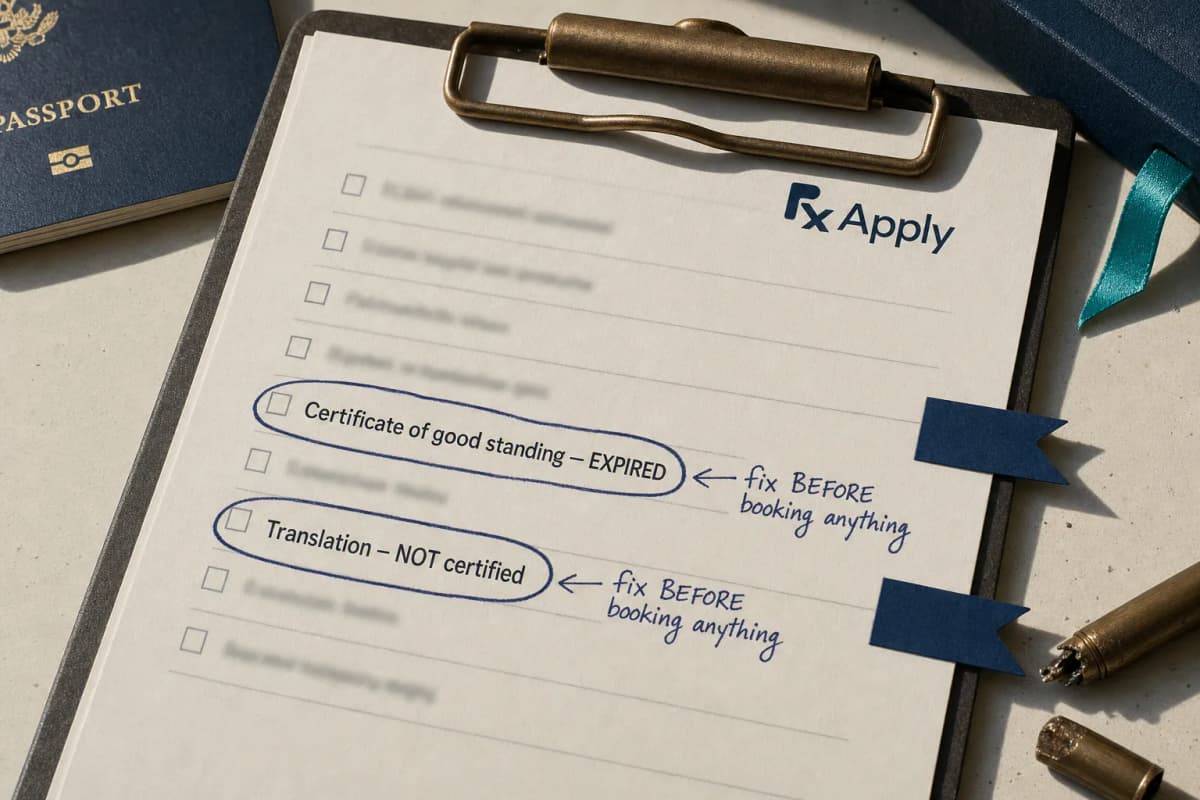
Eleventh — abandoning the dated documents during the celebration. Between the final exam pass and licence registration, the expiring certificates (Good Standing, police clearance, language scores) must stay valid; many expire in precisely that gap and stall registration for months.
Twelfth — choosing the city by habit, not data. Test the Toronto/Sydney/London default against the numbers: the regional markets usually offer higher income, less competition, and a smoother residency path — especially for the first five years.
Thirteenth — financial drift after the first salary. With no tax treaty and no pension agreement with your home country, your financial life in the destination starts from zero; year one is for closing three things: the right insurances, the destination's retirement savings, and a credit history.
The antidotes, on one line each
Before starting: criteria-based country choice ✓ language started ✓. The documents phase: the chain's order ✓ certificate wording (title, hours, als Zahnarzt) ✓ dated records synced to submission ✓. The exam phase: current, dated data ✓ format-trained practical preparation ✓ every attempt fully prepared ✓. Strategy: a live second track ✓ immigration rail running parallel ✓. Finance: transparent, documented payments ✓ staged currency conversion ✓. And everywhere: documents over hearsay ✓.
Turn that list into a personal plan — with a date and an owner (you) for every line — and you will have replaced dozens of consulting hours with something more precise.
The suggested starting point: the five-destination comparison, then your chosen country's full guide.
About this article. RxApply is an independent education provider. It is not affiliated with, approved, endorsed by, or connected to GDC, ADC or NDEB. This is general educational information about published licensure processes — not legal, immigration, or professional advice.